Researchers emphasize there are very few circumstances in which you can do two things at once without cost (relative to doing each on its own). Yet some drivers sneak a look at their phone while on the road, and some students have the television playing while they complete an assignment.
Why? One possibility is that they don't understand the cost of multi-tasking very well. A new study (Finley, Benjamin, and McCarley, 2014) investigated that possibility.
Subjects initially practiced a tracking task: a small target moved erratically on a computer screen and the subject was to try to keep a mouse cursor atop it.
Interleaved with practice on the tracking task, subjects practiced a standard auditory N-back task: they heard a series of digits (one every 2.4 seconds) and were asked to say whether the digits matched the one spoken 2 digits earlier (or in other versions of the task, 1 digit or 3 digits earlier).
After a total of 3 phases of practice for each task, subjects were told that they would try to do both tasks at the same time. They were told to prioritize the tracking task; just as a driver must keep the car in the lane, they should do their best to keep the cursor near the target, but they should do their best on the N-back task.
Then subjects got feedback on their performance on the three phases of tracking task (expressed as percent time they had the cursor on the target) and they were asked to predict their performance on the tracking task when simultaneously doing the N-back task.
The results showed a significant drop in tracking performance when subjects had to do the N-back task at the same time. What did subjects predict?
Subjects did predict a decrement. What they could not do was predict the size.
The graph shows the correlation between the predicted decrement in tracking performance and the actual decrement.
Why? One possibility is that they don't understand the cost of multi-tasking very well. A new study (Finley, Benjamin, and McCarley, 2014) investigated that possibility.
Subjects initially practiced a tracking task: a small target moved erratically on a computer screen and the subject was to try to keep a mouse cursor atop it.
Interleaved with practice on the tracking task, subjects practiced a standard auditory N-back task: they heard a series of digits (one every 2.4 seconds) and were asked to say whether the digits matched the one spoken 2 digits earlier (or in other versions of the task, 1 digit or 3 digits earlier).
After a total of 3 phases of practice for each task, subjects were told that they would try to do both tasks at the same time. They were told to prioritize the tracking task; just as a driver must keep the car in the lane, they should do their best to keep the cursor near the target, but they should do their best on the N-back task.
Then subjects got feedback on their performance on the three phases of tracking task (expressed as percent time they had the cursor on the target) and they were asked to predict their performance on the tracking task when simultaneously doing the N-back task.
The results showed a significant drop in tracking performance when subjects had to do the N-back task at the same time. What did subjects predict?
Subjects did predict a decrement. What they could not do was predict the size.
The graph shows the correlation between the predicted decrement in tracking performance and the actual decrement.
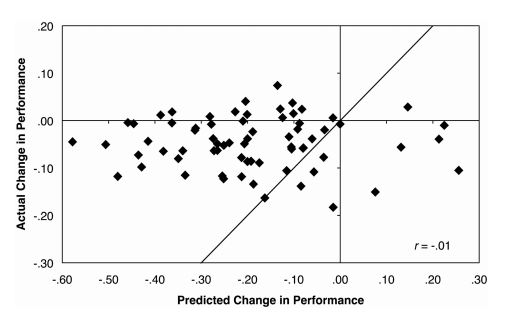
The diagonal shows perfect prediction
Subjects were not just wildly guessing. Their predicted performance in the dual task situation was related to their performance in the single-task situation, as shown here:
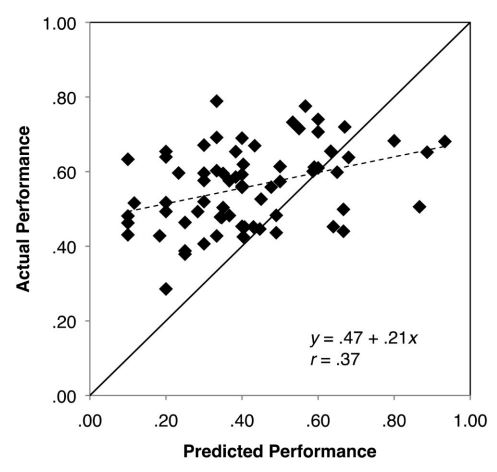
Dual-task performance as a function of single-task performance
So to make the judgment "how much will it hurt my tracking performance to add a second task?" subjects take their single-task tracking performance and subtract something. . . but the "something" is not accurate.
The analogy to typical dual-task situations is not that great. In this case, I have never performed the two tasks simultaneously and am asked to guess at performance when I do. When a student decides to watch television while completing an assignment, he very likely has completed those tasks in a dual-task situation.
This means he has two ways of predicting his performance: one would be guessing at the dual-task cost, and this experiment shows that although subjects know there is some cost, they are terrible at predicting its size.
The second way students could predict what will happen if they multitask while working is based on their memory of similar situations. But the feedback students get in this situation is unclear. First, the feedback is significantly delayed, relative to when the work is completed. Second, every assignment varies (and so do tv programs) so the student might attribute bad performance to one of those variables (although I don't know of any study showing no cost to background television).
But there is another interpretation of students' choice to multitask. They know their performance will suffer, they know they don't know how much it will suffer, and they don't care.
Reference:
Finley, J. R., Benjamin, A. S., & McCarley, J. S. (2014). Metacognition of multitasking: How well do we predict the costs of divided attention? Journal of Experimental Psychology: Applied, in press.
The analogy to typical dual-task situations is not that great. In this case, I have never performed the two tasks simultaneously and am asked to guess at performance when I do. When a student decides to watch television while completing an assignment, he very likely has completed those tasks in a dual-task situation.
This means he has two ways of predicting his performance: one would be guessing at the dual-task cost, and this experiment shows that although subjects know there is some cost, they are terrible at predicting its size.
The second way students could predict what will happen if they multitask while working is based on their memory of similar situations. But the feedback students get in this situation is unclear. First, the feedback is significantly delayed, relative to when the work is completed. Second, every assignment varies (and so do tv programs) so the student might attribute bad performance to one of those variables (although I don't know of any study showing no cost to background television).
But there is another interpretation of students' choice to multitask. They know their performance will suffer, they know they don't know how much it will suffer, and they don't care.
Reference:
Finley, J. R., Benjamin, A. S., & McCarley, J. S. (2014). Metacognition of multitasking: How well do we predict the costs of divided attention? Journal of Experimental Psychology: Applied, in press.

