School Leadership 2.0
A Network Connecting School Leaders From Around The Globe
Using Roles in Group Work

Using Roles in Group Work
While collaborative learning through group work has been proven to have the potential to produce stronger academic achievement than other kinds of learning 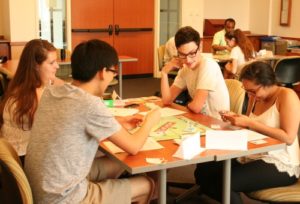 environments (Johnson, Johnson, & Smith, 2006), it can be challenging to implement successfully because many students come to college without the tools they need to automatically succeed in collaborative learning contexts. One way of providing supportive structures to students in a collaborative learning environment is through assigning roles within group work.
Potential Benefits of Using Assigned Roles in Group Work
Assigning group roles can be a beneficial strategy for successful group work design for a number of reasons:
- Group roles offer an opportunity for high quality, focused interactions between group participants. Participants are more likely to stay on task and pay closer attention to the task at hand when their roles in the collaboration are clear and distinct.
- Group roles provide all students with a clear avenue for participation. Students are less likely to feel left out or unengaged when they have a particular duty that they are responsible for completing. Along the same lines, assigning group roles reduces the likelihood of one individual completing the task for the whole group, or “taking over,” to the detriment of others’ learning.
- Group roles encourage individual accountability. Group members are more likely to hold each other accountable for not completing work if a particular task is assigned to them.
- Group roles allow students to strengthen their communicative skills, especially in areas that they are less confident in volunteering for.
- Group roles can help disrupt stereotypical and gendered role assignments, which can be common in group learning. For example, Hirshfield and Chachra (2015) found that in first-year engineering courses, female students tended to undertake less technical roles and more communicative roles than their male colleagues. By assigning roles during group work, and by asking students to alternate these roles at different points in the semester, students can work past gendered assumptions about themselves and their groupmates.
POGIL: A Model for Role Assignments in Collaborative Learning
One small group learning methodology where the use of group roles is well-defined and researched is the Process Oriented Guided Inquiry Learning (POGIL) method. The POGIL method calls for groups of three or four students who work in a team on process-oriented guided inquiry activities in which students construct their knowledge through interactions with others. Traditional POGIL roles for group members are provided below (POGIL, 2016).
- Manager or Facilitator: Manages the group by helping to ensure that the group stays on task, is focused, and that there is room for everyone in the conversation.
- Recorder: Keeps a record of those who were in the group, and the roles that they play in the group. The recorder also records critical points from the small group’s discussion along with findings or answers.
- Spokesperson or Presenter: Presents the group’s ideas to the rest of the class. The Spokesperson should rely on the recorder’s notes to guide their report.
- Reflector or Strategy Analyst: Observes team dynamics and guides the consensus-building process (helps group members come to a common conclusion).
For more information on implementing these roles you can visit POGIL’s website.
Other Highly Adaptable Roles to Consider
You can adapt roles for different kinds of group tasks. While the POGIL model is a useful place to start, you may find that the tasks associated with your discipline require other kinds of roles for effective group learning. Adding to or reframing POGIL roles can be beneficial in these contexts. Below are some suggestions for additional roles that might be valuable to a variety of learning situations.
- Encourager: Encourages group members to continue to think through their approaches and ideas. The Encourager uses probing questions to help facilitate deeper thinking, and group-wide consideration of ideas.
- Questioner: Pushes back when the team comes to consensus too quickly, without considering a number of options or points of view. The questioner makes sure that the group hears varied points of view, and that the group is not avoiding potentially rich areas of disagreement.
- Checker: Checks over work in problem solving contexts before the group members finalize their answers.
Strategies for Effective Facilitation of Group Roles
The following suggestions are strategies for effective facilitation of group roles. These strategies are helpful in a wide variety of group work situations, but are essential for group work that will last beyond a single class period, or constitute a significant portion of student grades.
- Be transparent about why you are assigning group roles. This kind of transparency can increase student buy-in by helping them recognize the value in establishing group roles
- Provide students with a list of roles and brief definitions for each role at the beginning of the group work activity. Make it clear which tasks are associated with which roles.
- Alternatively, you may find it helpful, especially in advanced-level classes, to encourage students to develop their own roles in groups based on the tasks that they feel will be critical to the group’s success. This strategy provides the students with a larger level of autonomy in their learning, while also encouraging them to use proven structures that will help them be successful.
- Roles can be assigned randomly through a variety of strategies, from who has the next birthday to color-coded post-it notes, or a place card that points out roles based on where everyone is sitting.
- Circulate early in the class period to be sure that everyone has been assigned a role, and that everyone is clear about what their responsibilities include.
- Be willing to reinforce the given roles throughout the activity. For roles to work, students have to feel as though they will be held accountable for fulfilling those roles. Therefore, it is critical for you to step in if you see someone taking over someone else’s role or not fulfilling their assigned role. Often gentle reminders about who is supposed to be doing what can be useful interventions. For example, if someone is talking over everyone and not listening to their other groupmates, you might say something like “Remember, as a spokesperson, your job is to represent the ideas of everyone in the group.”
- Talk with students individually if their speech or conduct could be silencing, denigrating, or excluding others. Remember: your silence on this issue may be read as endorsement.
- Changing things up regularly is imperative. If you use group roles frequently, mixing up roles throughout the semester can help students develop communication skills in a variety of areas rather than relying on a single personal strength.
- If this is a long-term group assignment, be sure to provide structures for individual feedback for the instructor and other group member on group dynamics. This could be a formal or informal check in, but it’s critical for students to have a space to voice concerns related to group dynamics—especially if this assignment counts for a large portion of their final grade. This feedback might be provided through an anonymous survey in paper form or through a web-based tool like Qualtrics or a Google form. These check-ins can reduce student anxiety about the potential for uneven group participation.
Overall, using assigned roles in group work provides students with a supportive structure that promotes meaningful collaborative learning. While group learning can be challenging to implement effectively, using roles can mitigate some of the challenges associated with learning in groups, while offering students the opportunity to develop a variety of communication skills that will be critical to their success in college and their future careers.
References & Further Resources
Burke, Alison. (2011). Group work: How to use groups effectively. The Journal of Effective Teaching, 11(2), 87-95.
Beebe, S.A., & Masterson, J.T. (2003). Communicating in small groups. Boston, MA: Pearson Education.
Cheng, W. Y., Lam, S. F., & Chan, C. Y. (2008). When high achievers and low achievers work in the same group: The roles of group heterogeneity and processes in project‐based learning. British Journal of Educational Psychology, 78(2), 205-221.
Eberlein, T., Kampmeier, J., Minderhout, V., Moog, R.S., Platt, T., Varma-Nelson, P., White, H.B. (2008). Pedagogies of engagement in science: A comparison of PBL, POGIL and PLTL. Biochemistry and Molecular Biology Education, 36(4), 262-73.
Hale, D., & Mullen, L. G. (2009). Designing process-oriented guided-inquiry activities: A new innovation for marketing classes. Marketing Education Review, 19(1), 73-80.
Hirshfield, L., & Chachra, D. (2015). Task choice, group dynamics and learning goals: Understanding student activities in teams. 2015 IEEE Frontiers in Education Conference: Launching a New Vision in Engineering Education Proceedings, FIE 2015, 1-5.
Johnson, C. (2011). Activities using process‐oriented guided inquiry learning (POGIL) in the foreign language classroom. Die Unterrichtspraxis/Teaching German, 44(1), 30-38.
Johnson, D. W., Johnson, R. T., and Smith, K.A. (2006). Active learning: Cooperation in the university classroom. Edina, MN: Interaction.
Moog, R.S. (2014). Process oriented guided inquiry learning. In M.A. McDaniel, R. F. Frey, S.M. Fitzpatrick, & Roediger, H.L. (Eds.). Integrating cognitive science with innovative teaching in STEM disciplines (147-166). St. Louis: Washington University in St. Louis Libraries.
The POGIL Project. (2017). https://pogil.org/
Springer, L., Stanne, M.E., & Donovan, S.S. (1999). Effects of small-group learning on undergraduates in science, mathematics, engineering, and technology: A meta-analysis. Review of Educational Research, 96(1), 21-51.
JOIN SL 2.0
SUBSCRIBE TO
SCHOOL LEADERSHIP 2.0
Feedspot named School Leadership 2.0 one of the "Top 25 Educational Leadership Blogs"
"School Leadership 2.0 is the premier virtual learning community for school leaders from around the globe."
---------------------------
Our community is a subscription-based paid service ($19.95/year or only $1.99 per month for a trial membership) that will provide school leaders with outstanding resources. Learn more about membership to this service by clicking one of our links below.
Click HERE to subscribe as an individual.
Click HERE to learn about group membership (i.e., association, leadership teams)
__________________
CREATE AN EMPLOYER PROFILE AND GET JOB ALERTS AT
SCHOOLLEADERSHIPJOBS.COM
New Partnership
Mentors.net - a Professional Development Resource
Mentors.net was founded in 1995 as a professional development resource for school administrators leading new teacher induction programs. It soon evolved into a destination where both new and student teachers could reflect on their teaching experiences. Now, nearly thirty years later, Mentors.net has taken on a new direction—serving as a platform for beginning teachers, preservice educators, and
other professionals to share their insights and experiences from the early years of teaching, with a focus on integrating artificial intelligence. We invite you to contribute by sharing your experiences in the form of a journal article, story, reflection, or timely tips, especially on how you incorporate AI into your teaching
practice. Submissions may range from a 500-word personal reflection to a 2,000-word article with formal citations. Click here to explore and contribute an article.
Also, consider the exciting learning opportunity offered through the Mentors.net AI Academy.
© 2026 Created by William Brennan and Michael Keany
Powered by

