
 REUTERS/Gary HeA blacked out New York City skyline on Oct. 29, as Hurricane Sandy made landfall in the northeastern United States. Go to related slide show »
Updated | Nov. 2
As New York City and the East Coast begin to recover from Hurricane Sandy, we offer some ideas for responding to the storm and its aftermath with students. We will continue to update this post.
For a quick overview, consult the Times interactive “Assessing the Damage From Hurricane Sandy” which reported on Oct. 30:
More than six million customers lost power Monday as Hurricane Sandy felled trees, downed power lines and flooded substations. The storm led to power failures in at least 17 states, including more than a million customers in Pennsylvania and New Jersey and about 660,000 in New York City. Roughly a quarter million customers lost power in Manhattan alone after a fiery explosion at a substation on East 14th Street, leaving nearly the entire island eerily dark south of 34th Street. Con Edison officials called the power failures “the largest storm related outage in our history.”
Below, some ways to bring Hurricane Sandy into the classroom. Please tell us how you’ll be teaching it. We want to collect ideas from classrooms around the region.
Images and Graphics as a Starting Point for Response:
Use the various images (including the photos sent in by Times readers), videosand graphics available on the Times site and elsewhere as a starting point to have students grapple with this storm and its scope. (Update: Nov. 1: theTimes Topics page on Sandy has links to much more multimedia.)
You might post the images around the classroom, gallery-style, or project them on a whiteboard, then ask students to respond in writing or in a class discussion; have them work in groups to raise questions for further inquiry; or discuss as a class what individuals and groups can do to respond to this disaster and its aftermath.
You might then choose among the many ideas below to take the conversation further.
Deadly Damage:
Read “Tracking the Storm,” ongoing Times coverage about all the damage Hurricane Sandy has caused up and down the Eastern Seaboard, including many deaths, millions of power failures (see video of the Manhattan Con Ed explosion on Oct. 29, above) the crane dangling over West 57th street in Manhattan, the patients who had to be evacuated from local hospitals and much more.
What stories, images or news items are most compelling, meaningful, moving or important to you? Why? Have students read this and other news reports and choose one aspect of the storm to learn about in more detail. You might then have them report their findings to each other jigsaw-style.
We also have two related Student Opinion questions, What Are Your Experiences With Severe Weather? and How Do You Help? to which we invite students to post their thoughts.
Hurricane Science and Math:
What is a hurricane? How does one form? Where are they found? Here is an overview and lesson from the National Oceanic and Atmospheric Administration and here are their general hurricane education resources. This simple hurricane game might also help students think about the factors that influence a storm’s intensity.
Then, explore the wealth of available weather data. Check out the path of Hurricane Sandy and compare it to the paths of other recent hurricanes. How do average wind speeds change with respect to distance to land? How quickly do storms dissipate once they make landfall? Estimate Hurricane Sandy’s total rainfall using this graph, or compare and contrast the different water levels along the coast using this map, both from the National Oceanic and Atmospheric Administration.
You can also find nine different lessons on hurricane anatomy, wind patterns, air pressure, heat transfer and more at the Science Education Resource Center at Carleton College.
Hurricane History:
Use this slide show of New York area hurricane history to learn about local hurricane history, or use the NOAA Hurricanes in History page to learn about those nationwide. How does Hurricane Sandy compare?
Contrast Sandy with other hurricanes in terms of storm tracks, damage caused, economic effects, impact on daily life or any other criteria. Students might then create an infographic showing the data visually.
To see other Times and Learning Network content about previous storms, including a whole collection on Hurricane Katrina, with links to reporting from 2005 as well as reports from the five-year anniversary in 2010, see our collection Teaching and Learning About Hurricanes.
A Late-October Surprise: Hurricane Sandy and Election 2012
 Jim Watson/Agence France-Presse — Getty ImagesRaymond Souza finished boarding up Tidal Rave’s 5 & 10 gift shop on the Rehoboth Beach, Del., boardwalk on Sunday.
Next Tuesday is Election Day, and Hurricane Sandy has thrown a wrench into the final sprint to the finish by disrupting the campaigns and early voting, and by putting a new issue on the table for voters: disaster response.
Read “Storm Pushes Presidential Race From Spotlight” and discuss any of the following questions:
- How long should the candidates suspend their traditional campaigning and fund-raising to honor the hardship that millions of people are facing in the storm’s aftermath?
- Will the storm provide President Obama with a late-game opportunity to appear presidential and in control? Will Mitt Romney be able to quickly resume his critique of the president’s policies?
- Will the federal government prove itself capable of providing relief in multiple states? Will federal disaster relief become a new issue in the campaign for the final week?
- New Jersey’s Republican Governor, Chris Christie, has praised the president and the federal disaster response several times so far — after spending the past several weeks attacking the president’s record on behalf of the Romney campaign. According to the article, some Republicans privately expressed frustration with Mr. Christie. You can read “In Wake of Storm, Christie Breaks From Attacks to Praise Obama” for more details and a video.
- Do disasters trump politics? Do they help politicians reach across the aisle? Or should politicians always be campaigning?
Read “Hurricane Sandy Likely to Be Biggest of Late-October Surprises” to learn about other recent hiccups in the final weeks of past presidential elections. Then, you might write an entry for 2012 describing this late-October surprise, and how it might be remembered in history.
Social Media Literacy:
During the storm, news and images circulated quickly via social media. (Poynter reported, for instance, that Instagram users were posting 10 Hurricane Sandy pictures every second at one point.)
Reports that the New York Stock Exchange was underwater and that sharks were swimming in front yards in New Jersey spread widely.
This piece from The Atlantic, “InstaSnopes: Sorting the Real Sandy Photos From the Fakes,” explores the stories and photos that circulated, helping readers understand which were real and which weren’t.
Before you read it, ask yourself, in a world where news can be reported by anyone with a cellphone, how do you decide what is true? What questions should you ask to find out? What personal rules might you develop to decide what news you post and when you post it? What harm might be done by not following those rules?
For instance, do you think this photograph of a carousel in Brooklyn,circulated on Twitter, is real or fake?
 Ana Andjelic
How about this Twitter message?
Flood waters rush in to the Hoboken PATH station through an elevator shaft. #Sandy pic.twitter.com/QosgFyOI

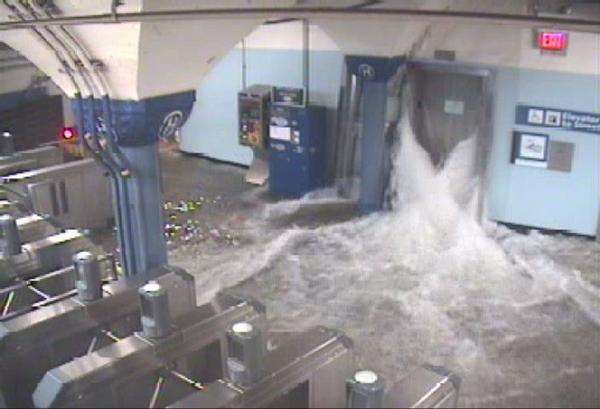
Read the Atlantic article to find out.
Economic Impact:
Investigate the economic consequences of the hurricane. How much revenue is lost when a Starbucks closes for the day? Or when 13,000 flights are canceled? Or when casinos shut down?
Do some research and make your estimates, and then read “Awaiting the Storm’s Price Tag” to explore more questions about the cost of the storm, and the cleanup. What predictions can you make about the storm’s economic effects in the coming days and weeks?
Update: Nov. 2: The article “Estimate of Economic Losses Now Up to $50 Billion” describes the unprecedented impact of the storm on a variety of industries, especially given the millions still without power.
Hurricanes and Climate Change:
What is the current thinking on what extent climate change leads to more hurricanes? You might consult the following sources for more information, then debate the question with your class, or create infographics to explain what you find:
(Updated Nov. 1 with more resources.)
- Are Humans to Blame? Science Is Out
- Op-Ed | Will Climate Get Some Respect Now?
- Bloomberg Backs Obama, Citing Climate Change
- “The #Frankenstorm in Climate Context” from the Dot Earth blog
- “Hurricanes and Climate Change,” from the National Center for Atmos...
- “Global Warming and Hurricanes,” from the Geophysical Fluid Dynamic...
- “Heating Up the Ocean,” from the Environmental Visualization Labora...
Storms and Political Leadership:
How should leaders respond to anticipated storms? They often get criticized afterward if the storm is weaker or stronger than what political leaders anticipated. With Hurricane Sandy, leaders rose to the storm challenge in different ways.
Have students read “Three Leaders, All Comfortable, Put Three Different Faces on Storm ...” and decide which leader — Gov. Andrew M. Cuomo, Mayor Michael R. Bloomberg or Gov. Chris Christie — they think had the best initial response to Hurricane Sandy. What criteria are they using to make their judgment?
Another Chance for FEMA:
The unwelcome arrival of Hurricane Sandy provides the Federal Emergency Management Agency with a golden opportunity to boost its reputation, seven years after its much-criticized response to Hurricane Katrina. What did the agency get wrong in 2005, and how will it do this time?
Students can read this story, research Hurricane Katrina and FEMA in the archives of The New York Times, and follow ongoing news coverage of the federal government’s handling of Hurricane Sandy. Then students can give FEMA their own report card with a letter grade, from A to F, including comments on its performance compared to previous disasters.
Nuclear Worries:
Experts are keeping a close eye on water levels at nuclear power plants affected by Hurricane Sandy, declaring an alert at the Oyster Creek plant in Toms River, N.J., after floodwaters came within one foot of disrupting normal cooling processes.
Just how dangerous is this situation? And can more be done to protect plants from disruptive flooding? Read these stories on measures taken at one Nebraska nuclear power plant in 2011 and safety reviews following the 2011 Fukushima disaster in Japan. Students can then write a list of safety recommendations for local officials.
The Psychology of Disaster:
Thousands of people fled their homes this week as Hurricane Sandy approached, but others didn’t heed the warnings or evacuation orders. Why do some people evacuate while others stay behind?
Read these accounts by people who went to emergency shelters or stayed home, and tabulate a list of their explanations for heeding or ignoring evacuation orders.
Then view this study and podcast on residents’ evacuation decisions during Hurricane Katrina, along with related research on how people react to fires. Students can then analyze whether the research backs up evacuation decisions they learned about during Hurricane Sandy.
Update: Nov. 2 | Common Core Practice Interrupted as Our New Jersey Classroom Collab...
The ninth graders and their teachers with whom we collaborate every Friday for a feature called Common Core Practice are without power and mourning the loss of the life they knew on the Jersey shore. In this post, Sarah Gross, one of the teachers, writes about what life has been like this week for her and for her students.
When Waters Recede, Projects Will Surface:
 Doug Mills/The New York Times“America is with you”: President Obama delivered a statement about Hurricane Sandy during a visit to the Red Cross on Tuesday in Washington. Go to related blog post »
In the wake of the hurricane, many teachers are apt to reconsider their curriculum to address this major event. If you are planning long-term, disaster-related, project-based learning, look for opportunities for students to explore open-ended questions and then share their work in authentic ways. Here are some ideas:
— After the devastating earthquake hit Japan in 2011, teachers from several schools across the country collaborated on writing projects to help their students make sense of what they and their families had experienced. In this blog post, Kim Cofino from Yokohama International School describes the evolution of a student publishing project called QuakeStories that used blogs, a wiki, and pen-pal exchanges to help students capture their first draft of history. The project offers a model for disaster recovery projects with students in the role of historians and storytellers.
—Using ePals, a free online platform for classroom collaboration, teachers can connect students with peers in other locations to discuss and learn about natural disasters in different parts of the world. An existing project, A Worldwide Look at Natural Disasters, makes use of multimedia resources from National Geographic. The project culminates with students presenting disaster preparedness plans for their regions and answering the question, “How ready are we?”
You can also use ePals to start your own collaborative project. For example, you might have students from different regions interview survivors of past disasters for a project that explores themes of resilience. (For more on how communities respond to disasters, read “How to Weather a Hurricane.”)
—Students who live outside the region affected by the storm may feel motivated to help. Put their critical thinking and empathy to work in a project that asks them to consider, “How can we do the most good?” In this case, students could research and evaluate different responses to humanitarian crises. For example, is it better to give money or “stuff” (like blankets or canned food)?
Students could then identify and evaluate different aid organizations and select one to support with an awareness campaign. (For more ideas, read the post, “What Causes Should Philanthropic Groups Finance? “)

