School Leadership 2.0
A Network Connecting School Leaders From Around The Globe
Reading by Third Grade: Thinking Beyond Retention by Robert Slavin

Reading by Third Grade: Thinking Beyond Retention
Everyone agrees that children who read well by third grade are far more likely than those who do not to succeed in later education and in life. For example, a recent report from the Annie E. Casey Foundation found that poor readers in third grade were four times more likely than adequate readers to eventually drop out of school. Based on this kind of information, many states have passed or are considering legislation requiring that students not reading at an established level by the end of third grade to repeat the grade. Usually, the legislation also includes some funding for schools to help struggling students meet the standard.
These state initiatives raise important questions. Are they good for the students who were retained? And are they good for the overall school system?
Retention has been studied for many years, and the research is reasonably clear. Children who repeat a grade do very poorly in reading and, ultimately, graduation rates compared similarly to their low-achieving age mates who were promoted. In comparison to their new grade mates, they show a short-term gain because they are older when they take the test, but this advantage wears off within a few years.
Reading-by-third-grade policies could end up being beneficial, however, because they provide substantial incentives to use effective strategies to prevent reading failure. Holding a child back is very expensive, incurring an extra year of per-pupil cost (roughly $10,000). Many states or districts have as many as 50 percent of third graders who might not meet the standards, so a school of 500 students holding back 50 percent of third graders would be failing about 35 children at a cost of $350,000 per year.
School leaders now have whatever their state gives them to reduce retentions, and they have a good reason to spend whatever it takes to reduce their retention rates and save a lot of money; $350,000 is a lot of money to solve a well-defined problem concentrated in pre-K through third grade.
There is no aspect of school improvement more extensively studied than preventing reading failure in the early grades. There are many proven programs, especially one-to-one and small-group tutoring, cooperative learning, and whole-school reform models.
But many schools in reading-by-third-grade states are simply hiring reading specialists to tutor children one-to-one. While tutoring can be very effective, in most schools one reading specialist cannot possibly tutor enough students to put them all over the line.
The research would suggest that different types of intervention are needed for different children depending on their age and how far behind they are, as in the made-up curve below. In this curve, students in the green section are likely to be reading at grade level, though high-quality teaching is still needed to keep them on track. Those in the yellow section are not on track for success, but are not too far from the criterion. Those in the orange and red zones need intensive help to reach grade level.
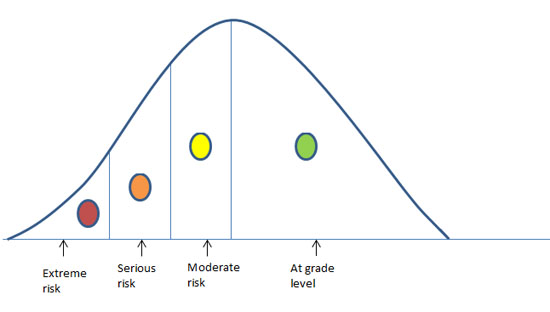
A school strategy only focused on the orange and red zones, with one-to-one tutoring, would not be very effective, as they have such a long way to go. Using tutors just for students in the yellow zone is ethically questionable and is still unlikely to get to enough children.
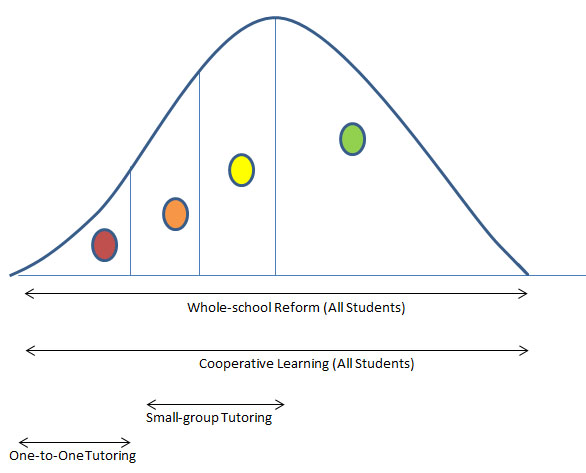
Instead, schools need a thoughtful, integrated strategy to get the maximum number of students to the standard. This could involve using proven but relatively inexpensive strategies for all students, high-quality small group tutoring for students in the yellow and orange zones, and high-quality one-to-one tutoring for children in the red zone, as illustrated below.
If schools use the reading-by-third-grade movement as an opportunity to use proven practices throughout the primary grades, they can reap substantial savings by avoiding unnecessary retentions, and most importantly, they can make a life-changing difference for all of their students.
JOIN SL 2.0
SUBSCRIBE TO
SCHOOL LEADERSHIP 2.0
Feedspot named School Leadership 2.0 one of the "Top 25 Educational Leadership Blogs"
"School Leadership 2.0 is the premier virtual learning community for school leaders from around the globe."
---------------------------
Our community is a subscription-based paid service ($19.95/year or only $1.99 per month for a trial membership) that will provide school leaders with outstanding resources. Learn more about membership to this service by clicking one of our links below.
Click HERE to subscribe as an individual.
Click HERE to learn about group membership (i.e., association, leadership teams)
__________________
CREATE AN EMPLOYER PROFILE AND GET JOB ALERTS AT
SCHOOLLEADERSHIPJOBS.COM
New Partnership
Mentors.net - a Professional Development Resource
Mentors.net was founded in 1995 as a professional development resource for school administrators leading new teacher induction programs. It soon evolved into a destination where both new and student teachers could reflect on their teaching experiences. Now, nearly thirty years later, Mentors.net has taken on a new direction—serving as a platform for beginning teachers, preservice educators, and
other professionals to share their insights and experiences from the early years of teaching, with a focus on integrating artificial intelligence. We invite you to contribute by sharing your experiences in the form of a journal article, story, reflection, or timely tips, especially on how you incorporate AI into your teaching
practice. Submissions may range from a 500-word personal reflection to a 2,000-word article with formal citations. Click here to explore and contribute an article.
Also, consider the exciting learning opportunity offered through the Mentors.net AI Academy.
© 2026 Created by William Brennan and Michael Keany
Powered by

