School Leadership 2.0
A Network Connecting School Leaders From Around The Globe
Meetings Waste Money, And Now You Can Calculate Just How Much
Meetings Waste Money, And Now You Can Calculate Just How Much
Use this in your pitch to remove a useless meeting from your schedule.
It's well known that companies waste a lot of time and money organizing and having meetings. We waste time endlessly emailing to find time-slots that suit everybody. We waste time waiting for everyone to arrive. We waste time discussing irrelevant points and tangential agendas.
Senior executives say more than half their meetings are "ineffective" or "very ineffective," a recent Bain & Company survey found. One large company studied by the consultants wasted a total of 300,000 hours a year as a result of just one weekly executive meeting, such was the "ripple effect" of one meeting leading to another. Moreover, Bain says the problem is getting worse. The amount of time devoted to meetings has increased each year since 2008, partly because meetings are now easier to organize and, because of video-conferencing technology, we no longer all have to be in the same room.
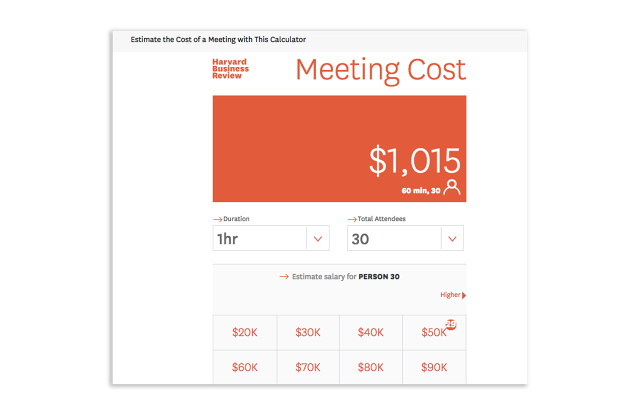
How much does all this undirected activity cost? For an answer, take a look at this usefullittle calculator created by the Harvard Business Review. Say five people have a meeting lasting 30 minutes and each person involved earns a salary of $60,000. That costs the company $105. Or, say you organize an hour-long meeting for 10 people and the average salary is $80,000. The cost is $560. Or what about an hour-long meeting for a whole department (30 people) where the average salary is $50k? That costs $1,015, not including coffee and cake (benefits are included though). You have to ask yourself: Is your meeting resulting in decisions that generate enough revenue to make it worth it? This is doubtful.
Time is an organization’s scarcest—and most often squandered—resource.
When salaries are really high, as in the company Bain studied, the results can be jaw-dropping. That weekly executive meeting cost a total of $15 million, even though a lot of what went on didn't translate into noticeable improvements in services, operations and products—i.e. the stuff companies are supposed to be focused on.
Bain suggests some possible fixes, including having "clear and selective" agendas, avoiding "initiative creep" (where one project piles upon another), and minimizing the number of people with the authority to call meetings in the first place. "Time is an organization’s scarcest—and most often squandered—resource," the consultants say. "No amount of money can buy a 25-hour day or reclaim an hour lost in an unproductive meeting."
Photo: Thomas Barwick/Getty Images
JOIN SL 2.0
SUBSCRIBE TO
SCHOOL LEADERSHIP 2.0
Feedspot named School Leadership 2.0 one of the "Top 25 Educational Leadership Blogs"
"School Leadership 2.0 is the premier virtual learning community for school leaders from around the globe."
---------------------------
Our community is a subscription-based paid service ($19.95/year or only $1.99 per month for a trial membership) that will provide school leaders with outstanding resources. Learn more about membership to this service by clicking one of our links below.
Click HERE to subscribe as an individual.
Click HERE to learn about group membership (i.e., association, leadership teams)
__________________
CREATE AN EMPLOYER PROFILE AND GET JOB ALERTS AT
SCHOOLLEADERSHIPJOBS.COM
New Partnership
Mentors.net - a Professional Development Resource
Mentors.net was founded in 1995 as a professional development resource for school administrators leading new teacher induction programs. It soon evolved into a destination where both new and student teachers could reflect on their teaching experiences. Now, nearly thirty years later, Mentors.net has taken on a new direction—serving as a platform for beginning teachers, preservice educators, and
other professionals to share their insights and experiences from the early years of teaching, with a focus on integrating artificial intelligence. We invite you to contribute by sharing your experiences in the form of a journal article, story, reflection, or timely tips, especially on how you incorporate AI into your teaching
practice. Submissions may range from a 500-word personal reflection to a 2,000-word article with formal citations. Click here to explore and contribute an article.
Also, consider the exciting learning opportunity offered through the Mentors.net AI Academy.
© 2026 Created by William Brennan and Michael Keany
Powered by

