
But, because they graduated from different schools, neither their education, nor their opportunities were equitable—even though they lived just 19 miles apart on the same Island. For example, Owen’s guidance counselors at South Side High School in Rockville Centre encouraged him to apply to New York University, while David’s Wyandanch Memorial High School counselors suggested that he apply to community college. Owen had ample help with his financial aid applications, but David did not.
“My guidance counselor, she’s all over the place,” David said in “A Tale of Two Schools,” a documentary produced by ERASE Racism, a Syosset-based nonprofit racial equality advocacy group. “So when she’s available I can ask her for help, but mostly I have to do stuff by myself.”
The cause of such disparity is found just outside the schoolhouse walls. Rockville Centre, where Owen lives, is 88 percent white, 9 percent Hispanic and he’s a member of the 4-percent African American minority, according to U.S. Census figures. In David’s hometown of Wyandanch, he’s one of the 65-percent majority of black residents—Hispanics make up 28 percent of that community, which is 16 percent white.
On May 17, 1954, the U.S. Supreme Court ruled in the landmark civil rights case Brown v. Board of Education of Topeka, K... that segregation of public schools is unconstitutional. Yet 60 years later, despite the nation re-electing its first black president, housing discrimination on LI—a national leader in racially segregated suburbs—perpetuates vastly unequal educational opportunities for minority students in poor neighborhoods versus those in affluent, white ones. The Island’s schools were reminiscent of the Jim Crow-era South, experts said in a recently released Columbia University study titled Divided We Fall: The Story of Separate and Unequal Schools 60 Years...
“If we came together to design a system that was going to segregate, it would be Nassau County,” Douglas Ready, associate professor of Education and Public Policy at Columbia University and contributing author of the report, said during a May 2 symposium.
Of course, segregation on LI is the region’s worst-kept secret. Hempstead residents recently won a federal lawsuit after a judge ruled Garden City’s zoning unfairly discriminated against minorities. Well-heeled Dix Hills sits atop mostly black Wyandanch, which Gov. Andrew Cuomo has dubbed “one of the most economically distressed communities on Long Island.” A report released on March 26 by the Civil Rights Project at UCLA branded LI “one of the most segregated and fragmented suburban rings in the country.”
Nancy Rauch Douzinas of the Garden City-based Rauch Foundation—which funded the Columbia study—cited UCLA statistics showing that the number of American suburbs deemed “intensely segregated” increased from 4-to-11 percent of the past two decades.
“We’re moving in the wrong direction,” she lamented.
PLACE NOT RACE
Those fighting racial discrimination embedded in the fabric of LI include Elaine Gross, president of ERASE Racism, an acronym short for Education Research Advocacy Support to Eliminate Racism.
Aside from helping to draft legislation to address the problem and suing municipalities when their policies violate the federal Fair Housing Act, the group also does public outreach to combat the seemingly insurmountable perception of privileged people that chalk up racial disparity to simple economics. In a recent Newsday article on the Columbia study, readers posted online comments that were almost all of a similar vein: if minorities could afford to buy homes in white neighborhoods, they would live there.
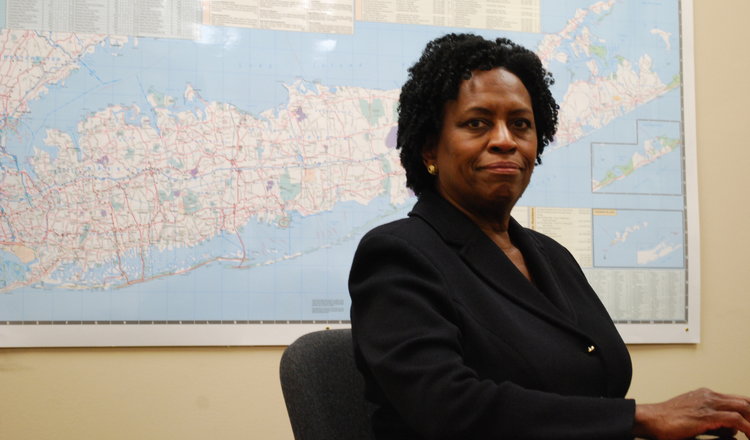
“That’s the thing that people frequently mistake,” Gross told the Press while seated at a conference table in her office, a map of LI featured prominently on the wall behind her. “They think that this is only about income when in fact, in one of our reports, we looked at every municipality on Long Island. In almost every single municipality on Long Island there was at least one housing discrimination complaint. So that means, the wealthier areas, the poorer areas—across the board—housing discrimination is about race. That’s what it is.”
Housing discrimination on LI plays out in a number of ways. Gross’ group recently filed a lawsuit against an apartment manager in Mineola, who’d allegedly discriminated against ERASE Racism testers who’d expressed interest in an advertised apartment. When the testers—African American actors from Manhattan—showed up to look at the apartment, the manager told them it was no longer available.
Landlords sometimes practice discrimination by telling minorities that the rent is higher than it really is, or presenting other roadblocks that make renting difficult or impossible. But, perhaps the biggest culprits in housing discrimination are real estate agents, according to Gross.
“The real estate agents are the most prevalent problem,” said Gross. “One of our board members relayed this story to me. When she came to take a job at Touro Law Center, she was steered. She didn’t know the communities. At the time, Touro was in Huntington. She said, ‘I’d like to be within certain radius.’ You know, she wanted to be near the law school. And the professors recommended different communities.
“So when she was meeting with different realtors, she would tell them, ‘I’m a professor at Touro. I hear these are good places,’” Gross continued. “And then she realized after the fact that they never seemed to show her places in those communities. They showed her places that were majority black. I know Huntington Station was one of the places they took her to. And they showed her houses that were less expensive than what she’d told them she could afford. So that, you know, was the other tip off. “
The professor’s experience is not unprecedented. According to a 2012 ERASE Racism study, “58 percent of respondents said that African Americans miss out on housing because real estate agents will not show blacks homes in white areas.”
And when it comes to the push for affordable housing on LI, U.S. Department of Housing and Urban Development (HUD) grants to local municipalities come with the caveat that funds must be used to “affirmatively further fair housing” under federal law. Otherwise, they could wind up like the Town of Oyster Bay, which the U.S. Attorney’s Office sued recently for allegedly violating that law.
“Municipalities like Oyster Bay, sometimes they build affordable housing, but they have resident’s preferences,” said Gross. “So if you already live in Oyster Bay, then you have a chance to get that affordable housing. But that policy has a discriminatory effect because there’s such a tiny portion of African Americans that live in Oyster Bay, versus the number of African Americans in Nassau County, not to mention the broader Island.”
Oyster Bay Town Supervisor John Venditto has denied the claims.
“It is just plain wrong to suggest that the Town of Oyster Bay is anything but a welcoming community to all people regardless of race,” he said in a statement. “We are now prepared to vigorously defend our housing programs in court, because these housing programs are vitally important to our community.”
TAX GAP
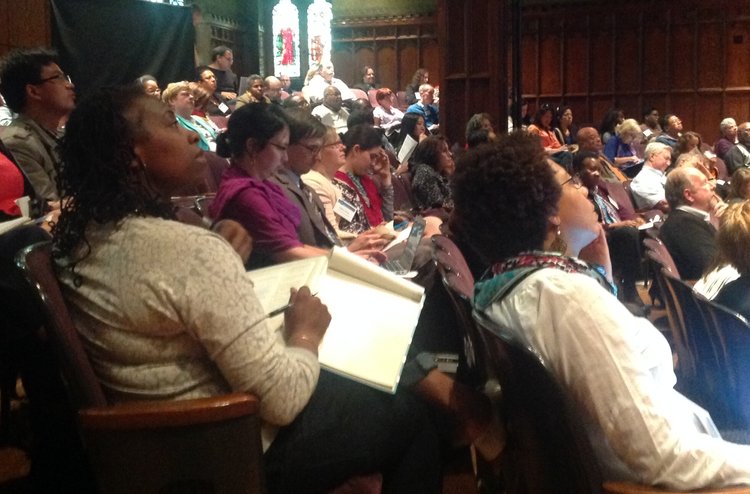
The crowded Milbank Chapel in Columbia University’s Teachers College during a symposium on school segregation May 2.
LI housing discrimination further feeds school segregation when black and Hispanic residents are steered into low-income communities, where lower property values provide less of a tax base for taxpayer-funded school districts, experts say.
In the “Divided We Fall” report, after conducting a five-year study of Nassau County and its public schools, researchers found that the racial makeup of a school district was one of the biggest influences of housing prices. By making apple to apple comparisons of homes, including years the homes were built, number of bathrooms, square footage, etc., they discovered that extreme divergence in housing prices where the only differences were school districts’ racial profiles.
“We have in America this patchwork of local-funding tax and real estate-based tax funding that the Supreme Court has defended again and again that basically incentivizes people to flee into enclaves so that their kids and their schools will be better funded and their kids will be okay,” said Brian Jones, former New York City school teacher who recently launched his campaign for lieutenant governor on the Green Party line. “It inevitably drains poor folks of the kind of tax base that they need to have better schools. Then the struggle to redistribute those resources becomes incredibly difficult.”
What’s the lesson in all of this?
“We learn is that the ‘value’ Nassau County residents place on their public schools—both in terms of ‘material value’ of the price of housing and the ‘emotional value’ of reputation, identity and appreciation of a place—is tightly tied to who lives in a given community and who attends the public schools,” he said. “Such evaluations, we argue, are forces of segregation and inequality.”
Market perceptions about the worth of homes perpetuate the notion that race is tied with under-performance in schools. The recent emphasis on high stakes test scores has accelerated an already stark contrast.
“Every time Newsday, in their infinite wisdom, prints another batch of test scores, it reinforces all the stereotypes,” said Arnold Dodge, an assistant professor of education at Long Island University, where he chairs the Department of Educational Leadership and Administration. “So you look down at the test scores and you go, ‘Look at Jericho. 99 percent.’ And then a few lines up is Hempstead at 32 percent.”
“What is the message to the casual observer?” he continues. “It’s ‘Oh My God, stay away from Hempstead. Look at those test scores.’ And the resulting media blitz reinforces all of the stereotypes so that the really wealthy communities feel better about themselves and the people in the poor communities have given up. And never the twain shall meet.”
Dodge is working with Berte van Wyk of Stelanbosch University in South Africa on the book The Courageous Conversations Project: Interrogating Perspectives and Perceptions of Race, Poverty, and Schooling in South Africa and the United States. He sees disturbing similarities in the racial and socio-economic disparity on LI and in post-Apartheid South Africa.
“If you look at the history of both countries, you look at historical racism, not only systemic and by law, but also in the consciousness of the people, we are very similar,” Dodge told the Press at Panera Bread in Hauppauge. “Is it comparable? Absolutely. And it has to do with wealth disparity and racism. And in both cases now, it’s no longer systemic. What’s really peculiar to me—kind of shocking in a way—is we all get so upset with a guy like Donald Sterling who makes these kinds of comments and what is he doing but being the voice of all of those people who want to live separately?”
His South African counterpart acknowledged the striking similarities between LI and his home country in recounting his experience driving from Hempstead into Garden City.
“As the car drove through am impoverished neighborhood, a community with apartments over storefronts, run-down buildings and black people walking up and down the streets, I was not surprised, knowing there were many such communities in the US,” he wrote in an advanced copy of the book. “What was surprising was that within less than a hundred meters the boulevard changed into a leafy and inviting street of wealthy homes with manicured lawns which I was told was an exclusively white enclave. I had to stop and take a photo up and down both ends of the street. The proximity of the disparity was breathtaking, reminiscent of my homeland where poor, black townships are within walking distance of magnificent homes, gated, secure and filled with white people.”
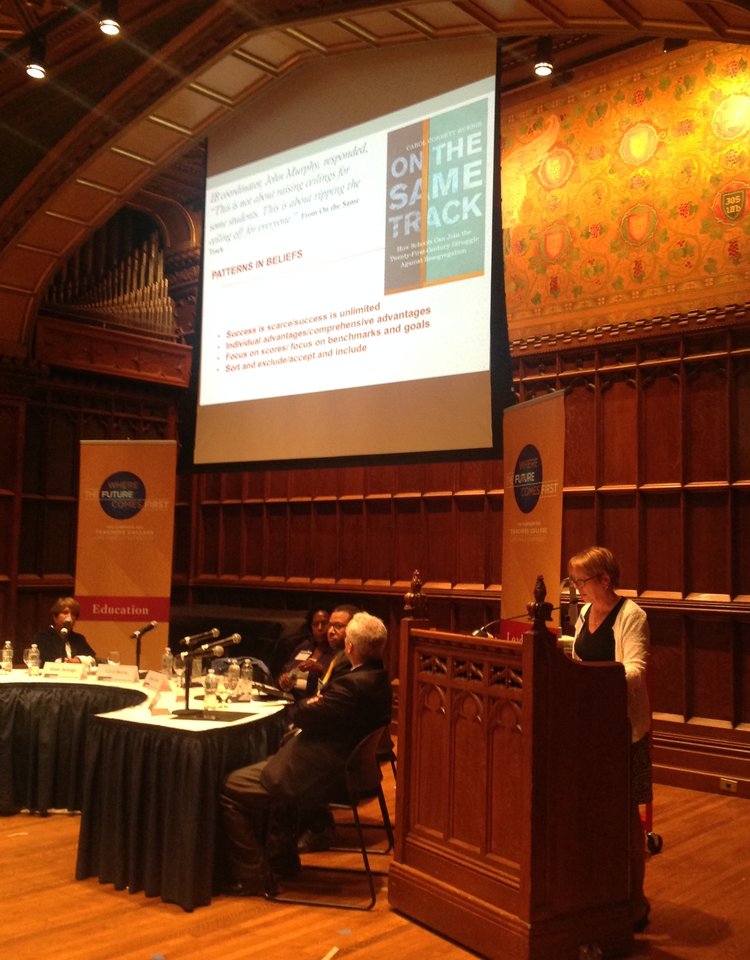
South Side High School in Rockville Centre principal Carol Burris addressing scholars, activists, educators and students at Milbank Chapel in Columbia University’s Teachers College during a symposium on school segregation May 2.
THE BOTTOM LINE
Kester Hodge, the principal of Wyandanch Memorial High School, acknowledges that his school is underfunded as a direct result of its zip code.
“In a school like Wyandanch, we already know that there are so many challenges that our students come with, but we don’t have the resources–the financial resources, to give the students what they need: more teachers, more school psychologists, more social workers,” he laments in the documentary. “Our school district doesn’t have a lot of businesses, so the money to fund these programs, and it does cost a lot of money to run these programs, has to come directly from the community.”
Although 2014 marks the 60th anniversary of the landmark school desegregation ruling, structural racism proves nearly impossible to undo in the classroom. Jones, the ex-teacher, said that intent of integration wasn’t historically about mixing black and white students. It was about making equal resources available to every student—an ideal that he argues the Island has failed spectacularly.
“In the history, the question of segregation or desegregation is often misconstrued as a question of the benefits of sitting next to a white kid,” Jones said. “When you go back and look at what the parent activists were saying in the ‘60s, it wasn’t about the white kids. It was about getting access to the resources that the white kids had. And the reality is in a segregated society, you’re never going to have separate and equal schools.”
Cold Spring Harbor serves as an example of how the economic disparity between school districts on LI could not be more extreme. Between surplus budgets based on tax income and private donations, the district has more money than it can spend. A 2009 report by Teachers College reports that in addition to $2 million AstroTurf fields (one for football and another for lacrosse), a “t-shirt shooter” for use at pep rallies, coffee machines and fresh water coolers for staff and students and state-of-the-art technology, there was enough funding left over for the district to have a blimp fly over pep rallies.
In addition, parents in the district spent untold thousands on private tutoring and private counselors to help students transition through common difficulties that affect many kids: divorce, drug abuse and learning disabilities. As opposed to a district like Wyandanch, where a depleted tax base leaves students without basic school supplies.
An unnamed assistant principal interviewed in the report was quoted as saying: “We’re not diverse at all, so we don’t have—we have one student who’s learning English, I believe she’s a Russian student. Um…so everyone comes motivated, well fed, well dressed…So much of our job is done for us, as opposed to other schools.”
Those “other schools,” where ELL students (English Language Learners) populate the campus, are faced with the challenge of adhering to unfunded mandates from the state that demand accommodations for inclusion into mainstream classes. State aid helps to bridge the gap, but not enough, experts say. Because of the ways many district boundaries are drawn, an aging populace or a wider community might disqualify a specific school district in need.
Michael Rebell, the executive director of the Campaign for Educational Equity and Professor of Law and Educational Practice at Teachers College at Columbia University, broke it down further.
“Great Neck with an 8 percent black and Latino population had a 10 percent poverty population spent $28,530 on average for each student, while nearby Elmont with a 75 percent black and Latino population and 48 percent poverty population spent $18,000,” he said at the symposium, referring to the years 2011-12. “That’s the fiscal inequity we’re living with.”
Then there are the cutbacks.
“It has not been even, by any means—not at all,” Rebell continued. “Since we’ve had these severe cutbacks in state aid, 22 percent of the low-wealth districts on Long Island had to cut back on high school athletics and 21 percent had to cut back on Advanced Placement courses, none of the high wealth districts had to reduce services in any of those areas. Last year, the Copiague School district had to reduce its starting teacher salaries by $7,000. How many highly qualified teachers do you think they’re going to attract in Copiague doing that?”
THE SEGREGATION WITHIN
When considering segregation on LI, it’s important to address not only the pattern of separation and racial disparity between communities and school districts, but within them.
“There’s two types of segregation,” said Dodge, the professor. “There’s within-school segregation and there’s within district, within communities and so forth. Even though a community might have on paper an integrated group, when you walk down the hallways, and the AP classes are filled with the white kids and over here is where we have the black kids, which is a hidden, invisible and dangerously innocuous thing because from the outside it looks like hey, we’ve got a community where everybody’s mixing and it isn’t true at all.”
Carol Burris, principal of South Side High School in Rockville Centre and author of On the Same Track: How Schools Can Join the Twenty-First-Century St..., credits an inclusive environment a successfully diverse student body. She wrote about her observations on tracking, an academic term for separating students into different classes based on perceived ability, offering different teaching methods and curriculum to different students.
The prevailing assumption among educators had been that tracking helped to address the needs of both low and high performing students. Yet, Burris found that students in lower tracks never seemed to live up to their potential. The culture of the lower tracks was one of disruption, low achievement and stalled ambition—and they were often populated with minority students.
This racial stratification gave Burris pause. Her critique was echoed by historic fights by civil rights groups against tracking based on IQ scores. In a 1976 U.S. Commission on Civil Rights report, they found tracking to be “the most common cause of classroom segregation.” This segregation has effects that both echo and perpetuate the racial hierarchy and inhibit social progress.
The question remained: was this beneficial for the students? Does tracking keep lower-ability students away from the higher-achieving students free each group up to focus on more enriching and difficult work? Do lower tracks offer the support needed to give under-performing students a chance to succeed?
Based on her experience and extensive research, Burris concluded that tracking did a disservice to lower-tracked students by offering them less engaged teachers and peers. She noted that lower-track students never seemed to move up into higher groupings. She adopted school-wide programs that elevated the curriculum to higher standards and eliminated tracks while making sure the school offered enough support for lower-achieving students so that they didn’t fall behind.
What happened next surprised her. The lower-achieving students steadily rose in achievement. And the higher-achieving students remained high, but with the added benefit of an enriched experience where they interacted with the entire student population.
“When you have cultural diversity in the class, it adds the dimension of understanding to the class,” Burris wrote in her book. “And amazing things start to happen.”
“Much of what you learn in class is not knowledge that people pour into your head,” Burris told the Press in a phone interview. “It comes from discussion. It comes from questions. It comes from point of view in a social studies class or in a literature class. And the discussions are so much richer for everyone if students get to hear the ideas of people who come from very different backgrounds and who have very different life experiences.
“I think having kids at different levels in the class helps everyone too,” she continued. “Sometimes in Honors classes, kids are afraid to ask questions. They’re deathly afraid that someone is going to think that they’re stupid or question why they don’t know it. In more and heterogeneous classes, kids seem to be less inhibited.”
This true mixing of both race and academic achievement seems to be leading South Side High School on the right track. Burris was named New York’s 2013 High School Principal of the Year by the School Administrators Association of New York State, among other accolades.
“If we’re ever going to see the real benefits of integration, we have to be willing not only to integrate at the school level, but also at the classroom level,” Burris said. “We can’t tolerate racially isolated schools. They just don’t work. Somebody somewhere has to find the courage to start working within with district boundaries or strategies to try to integrate our schools.”
TURN THE PAGE
Desegregating LI’s communities and, in turn, local schools, may be the biggest test the region faces.
“We have to do away with the local property tax bas for education funding,” said Rebell, the Columbia professor, citing Nixon-era studies that came to the same conclusion. “It’s as simple as that.”
Integration advocates suggest that desegregation can only happen by attacking the myriad systems that perpetuate the economic and racial disparity. What might LI look like after the dismantling the property tax funding of school districts, consolidating those districts, bringing affordable housing into affluent areas and eliminating tracking?
Mark Naison, professor of African-American Studies and History at Fordham University and director of Fordham’s Urban Studies Program, notes that “there are a lot of reasons schools are being re-segregated.”
“One is that there is no significant attempt either by political leaders or the courts, to integrate schools,” he said. “So much so that most civil rights leaders have given up on integration and have decided on a full-court press to improve schools in hyper-segregated neighborhoods, with an emphasis on charters. Me, I think there should be an emphasis on magnet schools and portfolio schools (schools exempt from testing) which consciously try to attract a multiracial population, but that strategy is out of favor.”
Rebell believes that consolidation is a necessary, but nearly impossible, step forward.
“If you have a rational plan that will save us money, and desegregate the schools, the voters in the 98-percent white district that has high property values and that has relatively high amounts of resources, they’ve got to vote to merge with a poor neighboring district that’s largely minority,” Rebell said at the symposium. “How many of those elections do you think pro-consolidation people are going to have won in the years since the recession—or in any years? I don’t think any.”
The question is what growing pains are Long Islanders willing to endure to make strides toward the promise of the Brown v. BOE? Can equalizing educational resources level the playing field for students? Will LI educators keep the ideal of that historic ruling in mind and work toward equal opportunity for all in the classroom?
“Aren’t we finding how absurd the argument is about separating if they do studies worldwide about inequality, the more disparity, the more society at large suffers?” asked Dodge. “The more you have the enclaves and the one-percenters and the wannabe-one-percenters, the less robust your economy is and the less strong your culture is. Ultimately, it isn’t even sustainable. It’s not going to work anyway. It’s so short-sighted.”
The answer is black and white.

