A MiddleWeb Blog
 Last week I was reading a recent article from Scientific American titledWhen I Grow Up: 5 Lessons Scientists Would Share with Their Younger.... I was cheering the emphasis that author Amanda Baker placed on the encouraging middle schoolers in STEM coursework and careers.Kudos!
But toward the end, a reader might be left with the impression that a science course, or a math course, or computer programming equals a STEM course. This common misunderstanding of STEM, generally described as the “silo” approach because it describes STEM in terms of stand-alone subjects, persists at many levels and can negatively affect the quality and success of K-12 STEM programs.
A STEM misunderstanding
Recall how the new Every Student Succeeds Act (ESSA) defines a STEM school or program: “. . . a school, or dedicated program within a school, that engages students in rigorous, relevant, andintegrated learning experiences focused on science, technology, engineering, and mathematics, including computer science, which include authentic school wide research.”

NAE PreK-12 Engineering Implementation
That definition dovetails withrecommendations from the National Academy of Engineering (NAE) and the National Academy of Science (NAS) emphasizing STEM as an integration of the four STEM subject areas through authentic, real-world, and concrete challenges.
How can we get across the idea that reducing STEM to just another way to say science, or math, or technology is counterproductive? Honestly, my guess is that a lot of the STEM money in the new ESSA plan will be frittered away on not-really-STEM programs. That’s probably not fair — frittered away — since it may strengthen middle school science and math teaching, for example, which would be a good thing. But let’s acknowledge the current confusion of focus concerning STEM programs and make sure we set up students for success.
What might a successful STEM program look like?
To start with, keep in mind that STEM is not comprised of four independent subjects taught in isolation from one another. STEM is, first and foremost, a way of teaching that helps prepare students for learning and working in the real world where they will spend the rest of their lives.
Picture this classroom scenario: Students are immersed in science, technology, engineering, and math as these exist in everyday life – interwoven and integrated. They transfer knowledge from the different subject areas and apply this learning in different situations to build understanding, retention, and skill. They do this by “engineering” answers to problems. Thus the “E”.
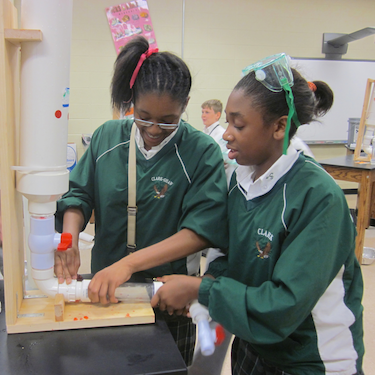
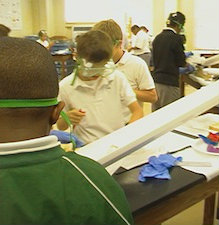 Kids in this classroom come alive and deepen their learning as they tackle local, national, and global issues. They use tools and other technologies to create and manipulate objects they built to address a dilemma. They are continually interacting and building successful social skills as they operate in teams, discuss possibilities, make joint decisions, and work together to find workable solutions.
Is that what you want your STEM program to look like? What things should be in place? Here, for what it’s worth, are 10 questions you might ask about your STEM program to clarify your direction.
Curriculum considerations
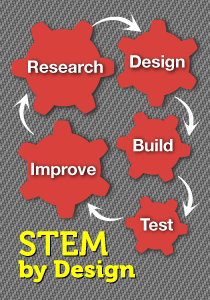
- Does an Engineering Design Process drive student thinking and decision-making as they work on the real world challenge?Engineering is the driving force behind STEM challenges and provides an organized process that can guide students in thinking through and solving problems.
- Are science, technology, engineering, and mathematics integrated and applied to solve real world problems and challenges in STEM lessons? One subject may weigh more heavily than another in any given challenge, but the connections among math and science, in particular, should be made explicit in the lesson.
- Is science and mathematics content within the STEM challenges deep, grade-level appropriate, and applied? One primary focus of STEM is to provide students with deeper and lasting understanding of science and mathematics principles, and with the ability to apply them to solve problems.
Teaching practices
 Do teachers use a student-centered, inquiry-driven, or project based approach that involves kids in active engagement and hands-on investigation? STEM classes are lively places where students explore, investigate, and create.
- Do classrooms provide a supportive, risk-free environment where failure is considered a normal step in the process of discovery?
- Do teachers connect the challenges students work on to specific STEM careers and applications? Students should understand how their STEM coursework will benefit them, even if they do not choose a STEM field.
- Do teachers have access to and time allotted for collaborative professional learning to sharpen their STEM knowledge and teaching approaches? STEM teachers must share expertise and stay current.
Student practices
 Are students working successfully together in teams? Productive teamwork doesn’t come naturally to middle schoolers. Teachers need to intentionally teach students how to work together and self-assess their progress.
- Are students brainstorming together, designing, and creating prototypes to solve the challenge? Are they testing and evaluating their prototypes’ performance and making decisions for redesign? These are important stages in engineering solutions. While all of these may not happen in any one lesson, over the course of STEM curriculum students should have opportunities to master each of these engineering design stages.
- Do students use effective communication approaches when describing their challenge and justifying their results and recommendations? Communication is a critical part of any STEM program and students must be able to communicate effectively within teams and to broader groups of people.
As you think about a STEM program in your school or class, make sure STEM means something important and valuable in your setting. Don’t use STEM as just a convenient acronym to describe what you are already doing in isolated courses. That won’t amount to much in the long run. Plan to launch the real deal and to possibly use ESSA funding as an opportunity to “do STEM right.”
Feature Image: Andrew Stawarz Creative Commons


