

As a first generation college graduate, a decision I made early in life was to have a growth mindset. If you’re new to the term growth mindset, or maybe just on the hunt for resources, check out Teaching Channel’s Growth Mindset Deep Dive. While many people assume things in my life have come easily, I’ve spent my entire existence struggling to succeed. Blessed or cursed (depending on your perspective) with an insane amount of drive as well as a natural curiosity toward all things, my life has been a constant cycle of discovery, failure, retooling, and — mostly — eventual success.
This lifestyle has carried over into my classroom, as I believe that regardless of the content I’m teaching, it’s my duty as an educator to prepare all of the young people that walk through my door to face the challenges that lie ahead of them. That’s why I’m such a staunch advocate for the incorporation of the engineering design process into all classrooms. The EDP is the epitome of growth mindset and transcends the classroom into every facet of day-to-day life.

In that spirit, I continue to refine my practice. Every year, I identify one area of my instruction as a point of emphasis. In the past, these areas have ranged from classroom management, to individualized learning plans, to the integration of technology. One area I’ve been putting off is refining the writing process that occurs within my STEM course. Why have I been putting it off? Quite honestly, I struggle with writing. I believe in the value of writing, but freely acknowledge that it’s not a strength I possess. Opening up this area of my practice could be humbling, but it’s my hope that we (myself as well as fellow educators) will all benefit from this experience.
In the spring of 2016, I was approached by a fellow educator in my district, Jen Tropp. Jen is a high school ELA teacher whom I’ve known since I was a teenager, and a trusted friend. She also happens to be on Greenon Local School’s Writing Across the Curriculum Committee. The group’s goals are to assess needs and then assist with the integration of writing in all classrooms and disciplines. Knowing I have a team to provide non-threatening, constructive feedback eliminated all excuses and let me know it was time to refine this area of my practice.
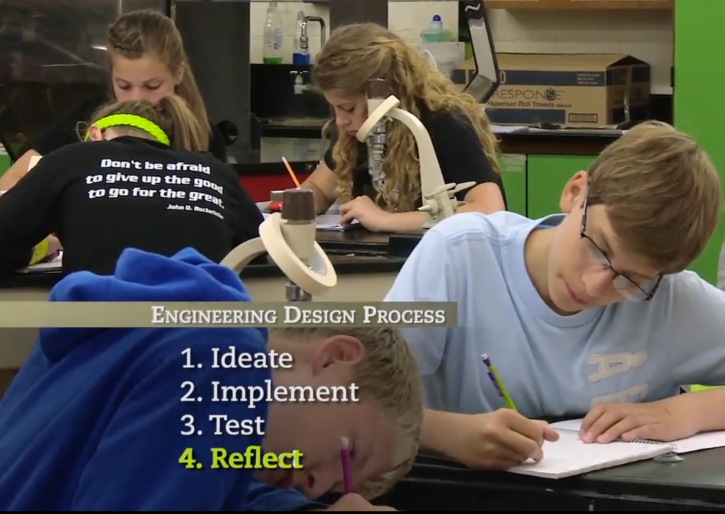
While opening up my classroom is never easy, I jumped at this opportunity and decided I’d use it to improve the engineering design journals required of my eighth grade STEM students. Up to this point, formal journals have been used intermittently. While spiral bound notebooks are used on occasion, they aren’t versatile enough to suit the needs of a wide array of projects. The guide sheets I provide for my students are very good, but are cobbled together from a couple of different sources and need to be tweaked to work in all situations.
My goal is to develop a flexible system that is consistent, allows for my students to make the journal their own, and allows each student to see not only the evolution of their product, but also the evolution of their ideas. As an educator, this system of documentation offers a deeper understanding of a student’s thought process. Not only can I see their answer (the product), but I can also learn more about how a student reached their conclusions (the process). Then I can find areas to place my own notes for remediation or to challenge the student to help take their thoughts to the next level.
My Teaching Channel EDP blogs and videos have generated quite a bit of interest amongst Tchers. One of the most frequent requests is for materials to support the utilization of engineering design journals. As I refine the writing that occurs within my classroom, I plan to share all of the materials I develop and adapt to suit my needs. In the meantime, I’m curious to learn more about the methods and tools you utilize within your learning space. If you have resources or comments, please feel free to share and open a discussion below. I’m looking forward to getting better together!
Tom Jenkins teaches both middle school science and STEM in Enon, Ohio. He is a NASA SOFIA Airborne Astronomy Ambassador, Teaching Fellow for the Whiting School of Engineering at Johns Hopkins University, as well as the Boeing Science Teacher Laureate for Teaching Channel. Connect with Tom on Twitter: @TomJenkinsSTEM.

