School Leadership 2.0
A Network Connecting School Leaders From Around The Globe
Forget Harvard: Here's Where To Go To College If You Want A High-Paying Job by Ariel Schwartz
Forget Harvard: Here's Where To Go To College If You Want A High-Paying Job
Prestige isn't everything.
Want a prestigious education? Harvard, Yale, and Princeton are the way to go. But if you're looking for a high-paying career after graduation, you may want to look elsewhere.
A new study from the the Brookings Metropolitan Policy Program ranks two- and four-year colleges based on economic outcomes for graduates—and none of the Ivy League even makes it to the top 10 for the four-year institutions. This is the data that the U.S. News and World Report rankings won't tell you.
Some of the major findings: Schools with high completion rates and good financial aid are linked to better economic outcomes. And schools with lots of students in STEM majors (like computer science and engineering), as well as majors with paths to higher paying careers in business and health care, also have superior financial payback.
 MITf11photo via Shutterstock
In order to come up with the rankings, researchers looked at three factors: mid-career earnings, occupational earnings (whether or not they're in a high-paying kind of career), and student loan repayment rates. Then, they compared to the baseline.
For mid-career earnings, this meant looking at what students would be expected to earn based on a number of factors—including SAT/ACT test scores, family income (based on Pell grant award amounts), race, gender, and type of college—and then comparing predicted earnings from a similar school with actual earnings, using data from PayScale.com. The difference between the two is the value added by their college.
"STEM is the biggest measurable factor on average across all the institutional factors," saysBrookings Fellow Jonathan Rothwell, who co-authored the report. "The only surprising thing is that it works even if you don’t go to an elite school. You don’t necessarily have to go to Caltech or MIT and major in computer science there. Even if you go to community college, you’ll see an earnings premium."
Here are the top four-year schools, based on mid-career earnings:
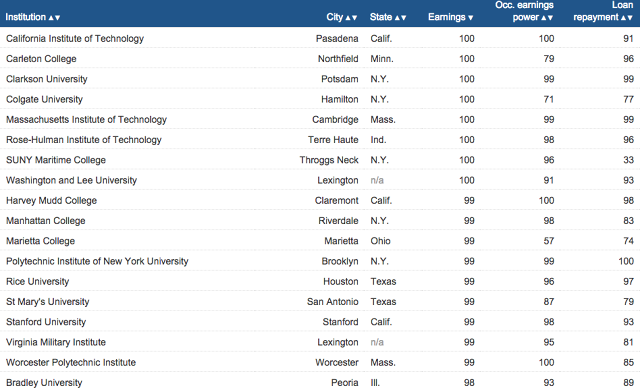
There are no Ivy League schools in that list, but there are some big-name tech schools. Still, some lesser-known places like the Rose-Hulman Institute of Technology made it to the top. MIT graduates have average mid-career earnings of $128,800, but Rose Hulman graduates aren't far behind, with earnings of $114,100. As for those rogue liberal arts colleges, like Carleton College and Colgate University? They're difficult to explain.
"They get there through what we call this X Factor. It's sort of hard to break it down because it’s kind of inherently unmeasurable, kind of like the dark matter of colleges. You can observe some energy affecting student performance in terms of higher earnings, better student occupations, and loan repayment rates," says Rothwell. He speculates that strong alumni networks, administrative staff that's adept at attracting big recruiters, and high-quality teachers could be contributors.
Here are the top two-year institutions:
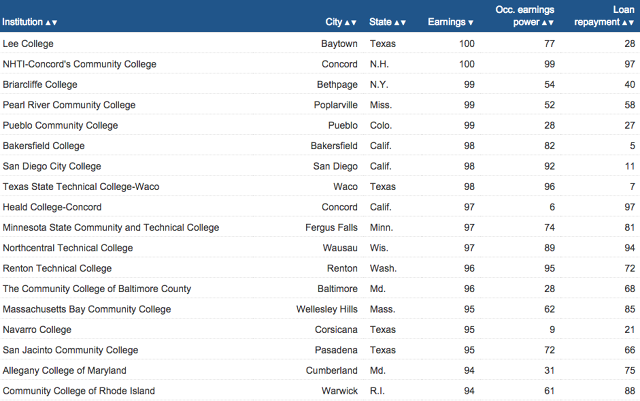
Students trying to get a sense of their future earnings may be better served by looking at these rankings instead of more traditional college rankings. "Most of their power in predicting future earnings is related to test scores of students going into [university]. Once you control for that, they don’t tell you much," says Rothwell. "For two fairly selective schools with similar admission rates, the rankings in U.S. News and World Report, Money, or Forbes, don't provide any extra information on economic success."
In addition to students, he believes that the data will be useful to regional and state leaders focused on education policy and workforce development, as well as schools themselves.
Check out the full rankings here.

JOIN SL 2.0
SUBSCRIBE TO
SCHOOL LEADERSHIP 2.0
Feedspot named School Leadership 2.0 one of the "Top 25 Educational Leadership Blogs"
"School Leadership 2.0 is the premier virtual learning community for school leaders from around the globe."
---------------------------
Our community is a subscription-based paid service ($19.95/year or only $1.99 per month for a trial membership) that will provide school leaders with outstanding resources. Learn more about membership to this service by clicking one of our links below.
Click HERE to subscribe as an individual.
Click HERE to learn about group membership (i.e., association, leadership teams)
__________________
CREATE AN EMPLOYER PROFILE AND GET JOB ALERTS AT
SCHOOLLEADERSHIPJOBS.COM
New Partnership
Mentors.net - a Professional Development Resource
Mentors.net was founded in 1995 as a professional development resource for school administrators leading new teacher induction programs. It soon evolved into a destination where both new and student teachers could reflect on their teaching experiences. Now, nearly thirty years later, Mentors.net has taken on a new direction—serving as a platform for beginning teachers, preservice educators, and
other professionals to share their insights and experiences from the early years of teaching, with a focus on integrating artificial intelligence. We invite you to contribute by sharing your experiences in the form of a journal article, story, reflection, or timely tips, especially on how you incorporate AI into your teaching
practice. Submissions may range from a 500-word personal reflection to a 2,000-word article with formal citations. Click here to explore and contribute an article.
Also, consider the exciting learning opportunity offered through the Mentors.net AI Academy.
© 2026 Created by William Brennan and Michael Keany
Powered by

