School Leadership 2.0
A Network Connecting School Leaders From Around The Globe
Americans Think Geniuses Are Men: Inside Our Contradictory Attitudes On Brilliance
Americans Think Geniuses Are Men: Inside Our Contradictory Attitudes On Brilliance
More people think Donald Trump is a genius than Bill Clinton. And 15% of people think that they are a genius themselves.
Fast Company
Jessica Leber
Quick, picture a genius. Your reflexive image is probably a man with wild hair who works, isolated, in a cluttered room. An Einstein or a Beethoven or a Da Vinci.
But what about modern day geniuses—how do we think about them? And what is genius, anyway, at a time when knowledge is becoming super specialized and creativity is at least as important as having a Mensa-level IQ? Are geniuses bred or born? Forces for good or evil?
A fascinating survey, conducted by the firm Edelman Berland for the 92nd Street Y, looks at American’s attitudes towards these questions about genius. In the survey, a representative sample of 2,043 adults answered questions online. The results say as much about our own cultural conditioning as they do about the geniuses who may or may not be living among us.
"This is a bit of a Rorschach about genius," says Gail Saltz, a psychoanalyst and psychiatrist who is helping to plan the 92nd Street Y’s "7 Days of Genius Festival," which kicks off next week in Manhattan. "When you ask people what they think, you’re asking the general public, not people who work in the field. You’re asking them how they relate to the concept."
Here’s a look at the most interesting results of the poll, titled "The Genius in US: 7 Days of Genius Poll Powered by Edelman Berland." And remember, how we think about geniuses matter in real-world ways, from the goals and aspirations we set for ourselves to the kinds of the education systems we set up for our children:
ALMOST EVERYONE THINKS GENIUSES ARE MEN

On average, 90% of respondents said that geniuses tend to be male, including 87% of women who participated in the survey—a concerning result to Saltz. "If you don’t think you’re capable of something, it makes it a lot less likely that you will reach for it," she says. The survey reflects that too: Women were less likely to be interested in being a genius than men.
The reason for this perception is understandable, however. "Historically, it’s been males who have had the opportunities and the recognition," says Saltz. "We tend to romanticize and revere geniuses of the past, because we can look back and say they really created substantial change. And so those icons still remain the rubric in which we think of genius."
WE THINK WE KNOW GENIUSES (OR MIGHT BE ONE OURSELVES)
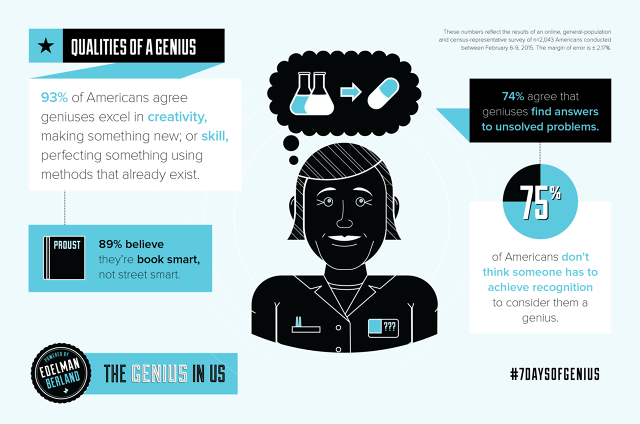
A potentially delusional 15% of people thought they might be a genius (Saltz uses the more polite term "overly optimistic"), while 43% of people think they personally know a genius, and 91% of people think "there are geniuses living among us." And yet—and yet—more than half of respondents (53%) though the label "genius" was overused, and 83% are skeptical if someone calls themselves a genius (presumably this doesn’t overlap with the 15% of survey respondents who did in fact do this).
Who's A Genius?
Respondents who agree this person is a genius:
Albert Einstein: 93%
Bill Gates: 75%
Stephen Hawking: 72%
Steve Jobs: 69%
Warren Buffett: 45%
Mark Zuckerberg: 44%
Neil deGrasse Tyson: 44%
Bill Nye: 37%
Malala Yousafzai: 33%
Jeff Bezos: 32%
Donald Trump: 29%
James Cameron: 22%
JK Rowling: 22%
Michael Jordan: 18%
Hilllary Clinton: 17%
Bill Clinton: 16%
Bono: 16%
Beyonce: 11%
Daniel Day Lewis: 11%
Kanye West: 11%
Louis CK: 8%
Actually, it’s really hard to get an objective measure of the rates of genius. That’s because there’s no one definition, unless you’re just going by straight IQ. Most people, though, have a sense that genius needs to produce something of value, not something abstract that just exists in someone’s head (70% of people believe geniuses impact society at large, not just "personal causes," though they don’t necessarily need to be recognized for their achievements). That’s one reason that Nobel Prizes are usually awarded only decades after a discovery; the prize committee wants to know that the discovery made a lasting impact on a field.
YOUNG PEOPLE SEEK GENIUS, MOSTLY IN TECH, BUSINESS, AND SCIENCE
More than 50% of people under the age of 54 would aspire to be a genius, especially in the Millennial age group. Fewer older people are interested, a finding that makes sense since most people (77%) believe genius becomes apparent at a young age. And a majority of Americans (65%) believe the world needs more geniuses, a number that also declines with age. Almost everyone believes geniuses are forces for "good" rather than "evil." This is a rather optimistic thought, since plenty of world-changing ideas have neutral morality.

People are also mostly interested in being geniuses in specific domains. The largest percentage, 21%, said technology, followed by business and finance (17%), followed by science and medicine (13%), followed by math (8%). Even fewer people were interested in being "genius" artists, writers, musicians, chefs, or philosophers, perhaps reflecting a bias toward professions where being a genius gets you rich.
Interestingly, though only 1% of people were most interested in being a genius politician, the category of politics led the survey in areas where people think the world is most "lacking" in geniuses. It probably doesn’t help that 29% of people think Donald Trump is a genius but only 17% think Bill Clinton is one.
OUR IDEAS OF THE LONE GENIUS ARE CHANGING
To Saltz, the survey shows that our understanding of genius is morphing, creating new ideas of what genius looks like. Where it was once very IQ-based, today, while you might have to be reasonably smart, extreme intelligence isn’t everything. "Creativity is a huge component of genius-level work. And that doesn’t always rely on having an extraordinarily high IQ," she says. "And many discoveries today are really team-based, which adds to the capacity for creative level because you have different minds added to the pot."
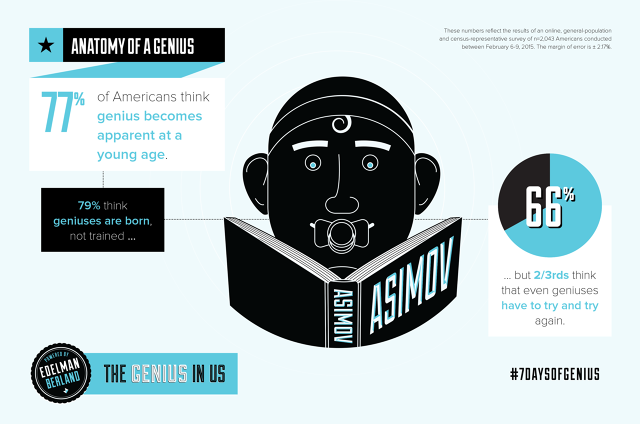
People’s mixed views about what makes a genius show in the survey results. While most people say geniuses are book smart and have a high IQ, the majority also say they are generally open-minded and more creative, intelligent, and articulate than geniuses were 50 years ago. And 54% of people say geniuses should be able to explain their work to anyone.
People are optimistic that we’ll see more geniuses in the future than in the past, and that we can produce more geniuses. Yet about half of respondents believe the U.S. education system "rejects genius." Is genius born or bred, and if so, how do we do this? Even if the word genius isn’t use, that’s one of the biggest debates today when we talk about encouraging more innovation and creative thinking in kids.
"Part of why we’re doing this 7 Days Of Genius Festival is because there’s a lot to explore around how we are really defining this," says Saltz. "We’ll discuss both the products [of genius], the need for defined result. And there will also be discussions really of ‘genius as a process’—the process of innovation, the process of being a disruptor. The level of creative, out-of-the-box thought necessary to do those things is somewhat a hallmark of genius."
JOIN SL 2.0
SUBSCRIBE TO
SCHOOL LEADERSHIP 2.0
Feedspot named School Leadership 2.0 one of the "Top 25 Educational Leadership Blogs"
"School Leadership 2.0 is the premier virtual learning community for school leaders from around the globe."
---------------------------
Our community is a subscription-based paid service ($19.95/year or only $1.99 per month for a trial membership) that will provide school leaders with outstanding resources. Learn more about membership to this service by clicking one of our links below.
Click HERE to subscribe as an individual.
Click HERE to learn about group membership (i.e., association, leadership teams)
__________________
CREATE AN EMPLOYER PROFILE AND GET JOB ALERTS AT
SCHOOLLEADERSHIPJOBS.COM
New Partnership
Mentors.net - a Professional Development Resource
Mentors.net was founded in 1995 as a professional development resource for school administrators leading new teacher induction programs. It soon evolved into a destination where both new and student teachers could reflect on their teaching experiences. Now, nearly thirty years later, Mentors.net has taken on a new direction—serving as a platform for beginning teachers, preservice educators, and
other professionals to share their insights and experiences from the early years of teaching, with a focus on integrating artificial intelligence. We invite you to contribute by sharing your experiences in the form of a journal article, story, reflection, or timely tips, especially on how you incorporate AI into your teaching
practice. Submissions may range from a 500-word personal reflection to a 2,000-word article with formal citations. Click here to explore and contribute an article.
Also, consider the exciting learning opportunity offered through the Mentors.net AI Academy.
© 2026 Created by William Brennan and Michael Keany
Powered by

