My approach to staff development (and teaching) borrows from the thinking of Donald Finkel who believed that teaching should be thought of as “providing experience, provoking reflection.” He goes on to write,
… to reflectively experience is to make connections within the details of the work of the problem, to see it through the lens of abstraction or theory, to generate one’s own questions about it, to take more active and conscious control over understanding. ~ From Teaching With Your Mouth Shut
Over the last few years I’ve led many teachers and administrators on classroom walkthroughs designed to foster a collegial conversation about teaching and learning. The walkthroughs served as roving Socratic seminars and a catalyst for reflection. But reflection can be a challenging endeavor. It’s not something that’s fostered in school – typically someone else tells you how you’re doing! At best, students can narrate what they did, but have trouble thinking abstractly about their learning – patterns, connections and progress. Likewise teachers and principals need encouragement and opportunities to think more reflectively about their craft.
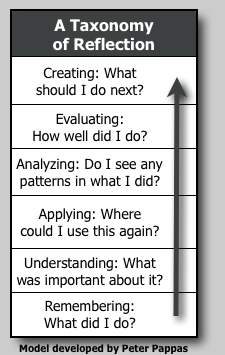
In an effort to help schools become more reflective learning environments, I’ve developed this “Taxonomy of Reflection.” – modeled on Bloom’s approach. It’s posted in four installments:
1. A Taxonomy of Reflection
2. The Reflective Student
3. The Reflective Teacher
4. The Reflective Principal
Take my Prezi tour of the Taxonomy
Educator Larry Ferlazzo writes: “I think Peter Pappas’ Taxonomy of Student Reflection is a brilliant way of looking at developing higher-order thinking skills through a new “lens.” It makes Bloom’s Taxonomy much more relevant and engaging to students than so many other Bloom’s strategies that are out there. And it can be an invaluable and simple tool for formative assessment — something that any teacher can regularly use in their classroom that only takes a few minutes. My students and I have used it for the past three years, I’ve strongly recommended it in two books, and prominently highlight Peter’s work in my blog.”
A Taxonomy of Lower to Higher Order Reflection
Assume an individual has just completed a task. What types of questions might they use to reflect on the experience? How might those questions parallel Bloom’s Taxonomy?
Bloom’s Remembering: Retrieving, recognizing, and recalling relevant knowledge from short- or long-term memory.
Reflection: What did I do?
Bloom’s Understanding: Constructing meaning from oral, written, or graphic messages.
Reflection: What was important about what I did? Did I meet my goals?
Bloom’s Applying: Carrying out or using a procedure through executing, or implementing. Extending the procedure to a new setting.
Reflection: When did I do this before? Where could I use this again?
Bloom’s Analyzing: Breaking material into constituent parts, determining how the parts relate to one another and to an overall structure or purpose.
Reflection: Do I see any patterns or relationships in what I did?
Bloom’s Evaluating: Making judgments based on criteria and standards.
Reflection: How well did I do? What worked? What do I need to improve?
Bloom’s Creating: Combining or reorganizing elements into a new pattern or structure.
Reflection: What should I do next? What’s my plan / design?

