School Leadership 2.0
A Network Connecting School Leaders From Around The Globe
10 GREAT FREE GOOGLE FORMS EVERY TEACHER SHOULD BE USING
10 GREAT FREE GOOGLE FORMS EVERY TEACHER SHOULD BE USING
Google Forms is a great free service by Google and that has a huge potential in education. Google Forms is very easy to use and does not require any advanced technology skills to run it. It is automatically built in Google Docs meaning it is completely web-based and does not require any software download. Anyway you can check this simple guide if you are not yet familiar with Google Docs .

Today's post, however, is about a great work that has been done by our colleague Tom Barret. He has created awesome example forms for different topics. He has also , thankfully , made all these forms availabe for us to download and use with our students. I have checked all his forms and I was really amazed by the great efforts he has put into them. You can use these forms with your students for sure but remember to keep in mind the great things you can do with Google Forms if you give it a little time.
Check out this list of forms below and click on any title to access its corresponding form. The pictures you see below are only half snapshots of each form:
1- Get to Know your Class

Use this form to collect information about your students such as their likes, dislikes, club affiliations, and many more.
2- Emotion Graph

This is a form ideal for use by students when studying linear narrative both written or visual. It basically compare a range of happiness to sadness against different points in a story or film.
3- Spelling Test
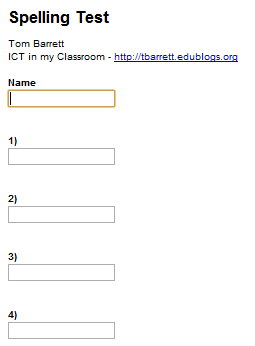
As its name suggests , this form is great for use inside the classroom to test students spelling.
4- Comprehension Questions
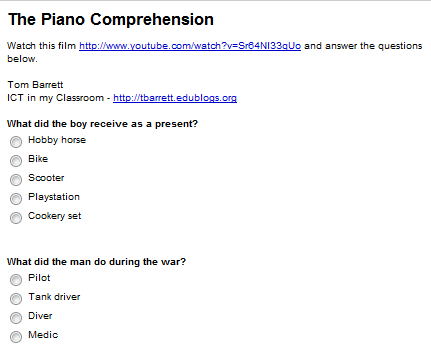
This is a form that test students understanding of a text or anything thing else you want to test. It can be used for multiple purposes.
5- Weekly Reading Record
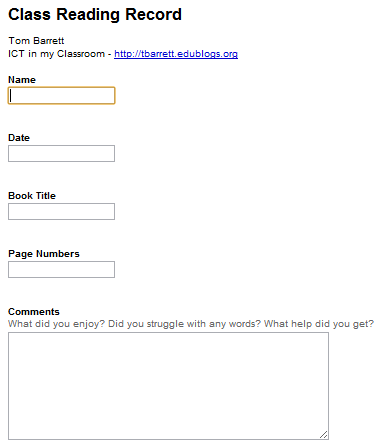
This is a form where students can provide data about their reading. It is like a reading diary that they can use to record informations about their readings.
6- Maths Data Handling
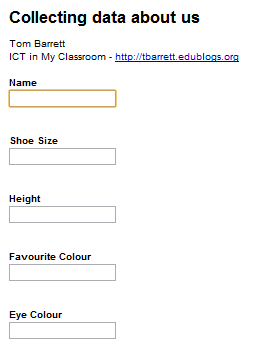
This one of the easiest forms you can use with your students in the classroom to gather Maths data handling information.
7- Guided Reading Record
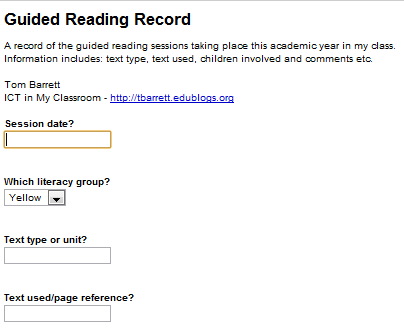
This is another awesome form to record students reading assignments.
8- Prior Learning Assessment
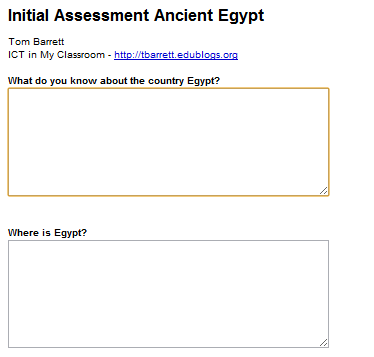
This is a form that can be used to assess what children already know about any given topic that you are beginning.
9- Library Book Review
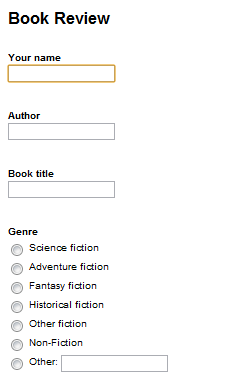
This form could be used to collect the children thoughts about what they read.
10- Learning Success

You can use this form to assess the relative success of the learning that has taken place during a single lesson or after a series of lessons on a topic.
JOIN SL 2.0
SUBSCRIBE TO
SCHOOL LEADERSHIP 2.0
Feedspot named School Leadership 2.0 one of the "Top 25 Educational Leadership Blogs"
"School Leadership 2.0 is the premier virtual learning community for school leaders from around the globe."
---------------------------
Our community is a subscription-based paid service ($19.95/year or only $1.99 per month for a trial membership) that will provide school leaders with outstanding resources. Learn more about membership to this service by clicking one of our links below.
Click HERE to subscribe as an individual.
Click HERE to learn about group membership (i.e., association, leadership teams)
__________________
CREATE AN EMPLOYER PROFILE AND GET JOB ALERTS AT
SCHOOLLEADERSHIPJOBS.COM
New Partnership
Mentors.net - a Professional Development Resource
Mentors.net was founded in 1995 as a professional development resource for school administrators leading new teacher induction programs. It soon evolved into a destination where both new and student teachers could reflect on their teaching experiences. Now, nearly thirty years later, Mentors.net has taken on a new direction—serving as a platform for beginning teachers, preservice educators, and
other professionals to share their insights and experiences from the early years of teaching, with a focus on integrating artificial intelligence. We invite you to contribute by sharing your experiences in the form of a journal article, story, reflection, or timely tips, especially on how you incorporate AI into your teaching
practice. Submissions may range from a 500-word personal reflection to a 2,000-word article with formal citations. Click here to explore and contribute an article.
Also, consider the exciting learning opportunity offered through the Mentors.net AI Academy.
© 2026 Created by William Brennan and Michael Keany
Powered by

