School Leadership 2.0
A Network Connecting School Leaders From Around The Globe
The REAL Feedback Experts in Your Building by Bill Ferriter
The REAL Feedback Experts in Your Building
Posted by Bill Ferriter on Wednesday, 05/11/2016
One of my best buds is a brilliant Canadian elementary school teacher named Diana Williams. She's this super motivated, talented woman who finds great ideas and then runs with them -- challenging both her own practice and the practice of others along the way.
Recently, Diana has been tinkering a bit with the feedback practices that I've been pushing here on the Radical -- and while chaperoning a school band trip to an out-of-town performance, she had a Eureka moment:
(click here to view image credits and download on Flickr)
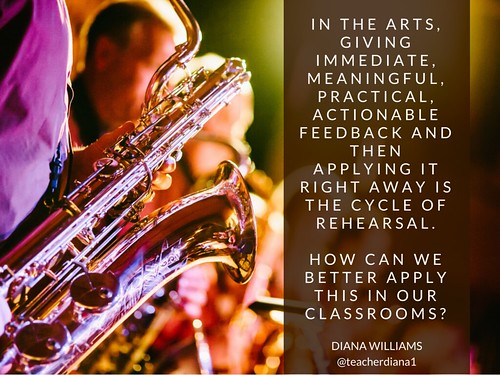
Diana's right, isn't she? There ARE places in our schools where high-quality feedback is the norm rather than the exception to the rule.
In fact, every art teacher, chorus teacher, band director and coach in your building knows just how to turn feedback into detective work for their students. After all, they've spent their lives polishing and perfecting knowledge and skills in performance-based fields. As Diana -- who was a musician before ever becoming a teacher -- explains:
In my own training I had this immediate feedback/application cycle and the thinking skills that are inherit in that process/feedback modeled for and with me and practiced until it became unconscious muscle memory.
That's true for your softball coach too, guys. And for your carpentry teacher and your auto mechanics instructor, your drama director, your family and consumer science teacher, and your dance instructor. They are all highly trained experts with first-hand experience with the kind of feedback/application cycle that Diana describes.
That also means every experience that your students have had in classes beyond the core curriculum has probably been FULL of examples of high quality feedback.
They've already learned to set goals and measure their progress against examples of excellence. They've already started identifying areas of personal strength and weakness -- and they've already felt the satisfaction that comes from discovering that forward progress IS possible.
THAT's why kids dig electives more than any other part of their day. It's the ONE place where they can see evidence of their own improvement on a moment by moment basis. And THAT's why we need to push against cheap attempts to cut "the specials" from our school days in order to save cash and/or prioritize "academics."
The simple truth is that learning to receive and react to feedback -- a skill that has natural connections to classes outside of the "core" curriculum -- may be the most important academic skill that students ever learn.
Comment
JOIN SL 2.0
SUBSCRIBE TO
SCHOOL LEADERSHIP 2.0
Feedspot named School Leadership 2.0 one of the "Top 25 Educational Leadership Blogs"
"School Leadership 2.0 is the premier virtual learning community for school leaders from around the globe."
---------------------------
Our community is a subscription-based paid service ($19.95/year or only $1.99 per month for a trial membership) that will provide school leaders with outstanding resources. Learn more about membership to this service by clicking one of our links below.
Click HERE to subscribe as an individual.
Click HERE to learn about group membership (i.e., association, leadership teams)
__________________
CREATE AN EMPLOYER PROFILE AND GET JOB ALERTS AT
SCHOOLLEADERSHIPJOBS.COM
New Partnership
Mentors.net - a Professional Development Resource
Mentors.net was founded in 1995 as a professional development resource for school administrators leading new teacher induction programs. It soon evolved into a destination where both new and student teachers could reflect on their teaching experiences. Now, nearly thirty years later, Mentors.net has taken on a new direction—serving as a platform for beginning teachers, preservice educators, and
other professionals to share their insights and experiences from the early years of teaching, with a focus on integrating artificial intelligence. We invite you to contribute by sharing your experiences in the form of a journal article, story, reflection, or timely tips, especially on how you incorporate AI into your teaching
practice. Submissions may range from a 500-word personal reflection to a 2,000-word article with formal citations. Click here to explore and contribute an article.
Also, consider the exciting learning opportunity offered through the Mentors.net AI Academy.
© 2026 Created by William Brennan and Michael Keany
Powered by


You need to be a member of School Leadership 2.0 to add comments!
Join School Leadership 2.0