Districts across the nation are determining teacher effectiveness in part using a rubric created by Charlotte Danielson. The rubric contains four domains and 22 components. You can download the full evaluation instrument here. The framework below outlines exactly what administrators will look for when evaluating teacher practice.
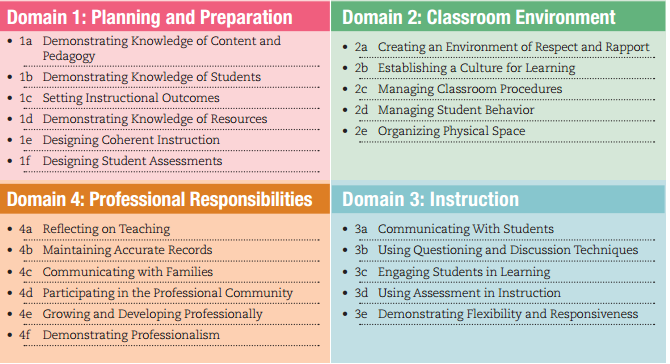
With four domains and 22 components, teachers might want to come up with a way to beautifully showcase and celebrate the work they are doing. To do that teachers must be familiar with what they are being asked to showcase. Teachers are responsible for demonstrating effectiveness through evidence and artifacts. In places like New York City, up to eight artifacts may be used to demonstrate effectiveness. They can only be used in domains one and four. Teachers should keep in mind however, that one artifact may demonstrate effectiveness in multiple components. For example, if you have a class Facebook page that you use to interact with students and their families, that Facebook page can serve as an artifact for both 4c - Communicating with Families as well as 1b - Demonstrating Knowledge of Students. This means, that should a teacher choose, they can use eight artifacts to demonstrate 12 components.
For domains two and three teachers must provide evidence of effectiveness. This evidence is generally collected during formal or informal classroom observations. Teachers also have the option to choose to videotape a lesson for their formal evaluation to provide evidence. It might be helpful for teachers to document, and have readily accessible, examples indicating how they are effectively engaging in each component.
Here are some ideas for showcasing and celebrating work using the Danielson Framework.
Use EduClipper to create a board for each domain and then attach clips to evidence and artifacts. Clips can be anything! Photos, documents, videos, and more.
Blog (free with Blogger)
Create a blog to capture artifacts and evidence. You may want to consider a standard format such as:
- Describing what you did.
- Sharing a link or embed code.
- Indicating and explaining which domain this addresses
Tag each post so that you can click on any component and share how you are teaching effectively.
Wiki (free with Wikispaces for educators)
Create a wiki and make a link in the sidebar for each domain. When you click on each domain, have that have links to each component. As you demonstrate effectiveness in various ways, share it on the wiki and then link that page to the appropriate component.
Flickr is a video and photo sharing site. For each picture or video you can include a comment and description. With Flickr you have a few choices. You could simply tag your pictures and videos to the corresponding domain and components or you can make an album for each domain that contains photos and videos of artifacts and evidence aligned to each of the components.
Showcasing our work
The Danielson rubric provides a beautiful framework for teachers to showcase, celebrate, share, and discuss our work. Collecting our work in these ways provides an opportunity for educators to do something that is not done nearly enough. It provides a terrific portfolio to showcase and celebrate the work we do in our classrooms with the world. It also serves as a fantastic tool for teacher reflection and discussion which is an extremely powerful professional development experience.
These are just a handful of ideas. How do you plan to showcase the work you are doing?
Showcasing our work
The Danielson rubric provides a beautiful framework for teachers to showcase, celebrate, share, and discuss our work. Collecting our work in these ways provides an opportunity for educators to do something that is not done nearly enough. It provides a terrific portfolio to showcase and celebrate the work we do in our classrooms with the world. It also serves as a fantastic tool for teacher reflection and discussion which is an extremely powerful professional development experience.
These are just a handful of ideas. How do you plan to showcase the work you are doing?


You need to be a member of School Leadership 2.0 to add comments!
Join School Leadership 2.0