School Leadership 2.0
A Network Connecting School Leaders From Around The Globe
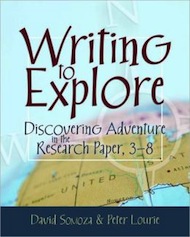
Writing to Explore: Discovering Adventure in the Research Paper by David Somoza and Peter Lourie
Writing to Explore: Discovering Adventure in the Research Paperby D...
(Stenhouse Publishers, 2010 – Learn more)
 Reviewed by Kevin Hodgson
Like many other teachers in states that have adopted the Common Core, I’ve been re-thinking the way we can approach research projects with my sixth grade students. The new standards not only increase the expectations of research-based reading and writing across the content areas, they also expect these skills to be taught in younger grades and with increasingly more complexity as the students get older.
 Strands of learning include finding information, evaluating claims of writers, citing sources, and writing frequently and extensively. Teaching all of those skills and more is made all the more difficult if the student writers are not invested in their projects, leading to dull and lifeless reports that were probably boring to write and are probably just as boring to read (sorry, kids).
Writing to Explore by David Somoza and Peter Lourie seeks to turn our concept of a research paper on its head, and while the book is explicitly aimed at grades 3-8, I would suggest that the main idea here – writing an adventure essay using real research and facts – might have a place in classrooms even beyond that grade range.
In fact, even with the Common Core, there are many places where the push towards expository and informational text writing is balanced by the effective use of narrative writing. Writing to Explore and the idea of a hybrid essay may be one path forward.
Blendingresearchfactsintoadventurouswriting
The book was conceived when Somoza, a teacher, began corresponding with Lourie, a writer of children’s books, about ways to help Somoza’s elementary school students become more invested as writers. Over time, what the two men realized is that a fusion of adventure-style writing buffered by facts and information from research could bring out the best of both worlds: fiction and non-fiction writing.
Their main project is built along the lines of a Heroic Quest story format, but the projects are rooted in a real place with real historic significance. The research phase of the adventure essay might seem familiar. It’s the gathering of important details and facts from a variety of reputable sources. But the presentation of that knowledge is done within the framework of a fictional adventure story, with emphasis on setting (so that the research can be used most effectively).
I appreciated the honest reflections here as Somoza shares how he implemented their ideas. The book is a nice mix of the letters that Lourie and Somoza sent back and forth (sometimes while Lourie was on location, scouting out settings for his own books), handy guidelines and teaching moments, and also some exemplary student work.
The adventure essay covers a lot of ground and might just hook those students (and teachers) to whom the phrase ‘research project’ conjures up groans and moans and dismay.
Kevin Hodgson is a sixth grade teacher in Southampton, Massachusetts, and is the technology liaison with the Western Massachusetts Writing Project. Kevin blogs regularly at Kevin’s Meandering Mind and tweets more often than is healthy under his @dogtrax handle.
JOIN SL 2.0
SUBSCRIBE TO
SCHOOL LEADERSHIP 2.0
Feedspot named School Leadership 2.0 one of the "Top 25 Educational Leadership Blogs"
"School Leadership 2.0 is the premier virtual learning community for school leaders from around the globe."
---------------------------
Our community is a subscription-based paid service ($19.95/year or only $1.99 per month for a trial membership) that will provide school leaders with outstanding resources. Learn more about membership to this service by clicking one of our links below.
Click HERE to subscribe as an individual.
Click HERE to learn about group membership (i.e., association, leadership teams)
__________________
CREATE AN EMPLOYER PROFILE AND GET JOB ALERTS AT
SCHOOLLEADERSHIPJOBS.COM
New Partnership
Mentors.net - a Professional Development Resource
Mentors.net was founded in 1995 as a professional development resource for school administrators leading new teacher induction programs. It soon evolved into a destination where both new and student teachers could reflect on their teaching experiences. Now, nearly thirty years later, Mentors.net has taken on a new direction—serving as a platform for beginning teachers, preservice educators, and
other professionals to share their insights and experiences from the early years of teaching, with a focus on integrating artificial intelligence. We invite you to contribute by sharing your experiences in the form of a journal article, story, reflection, or timely tips, especially on how you incorporate AI into your teaching
practice. Submissions may range from a 500-word personal reflection to a 2,000-word article with formal citations. Click here to explore and contribute an article.
Also, consider the exciting learning opportunity offered through the Mentors.net AI Academy.
© 2026 Created by William Brennan and Michael Keany
Powered by

