School Leadership 2.0
A Network Connecting School Leaders From Around The Globe
The American Academy of Pediatrics Says iPads Are Okay For Infants by Mark Wilson
 The American Academy of Pediatrics Says iPads Are Okay For Infants
by Mark Wilson
Fast Company
THE AMERICAN ACADEMY OF PEDIATRICS HAS DETERMINED THAT TV, SMARTPHONES, AND TABLETS ARE OKAY FOR THE YOUNGEST CHILDREN...WITH CAVEATS.
In the App Store, you’ll spot countless educational apps aimed at babies and toddlers. But thus far, there’s been a pretty large caveat that comes with the potential benefits of these experiences. The American Academy of Pediatrics has regularly discouraged any of this screen time, with a blanket recommendation to avoid TV watching and smartphone use by children under two. For children over two, they recommended the limits be set at two hours a day.
Now, following research analysis and opinions expressed by top neuroscientists and pediatricians during a two-day symposium the AAP ran in May on just this topic, the organization has rewritten its recommendations. Its biggest determination?
"Media is just another environment," according to the AAP. "Children do the same things they have always done, only virtually. Like any environment, media can have positive and negative effects."
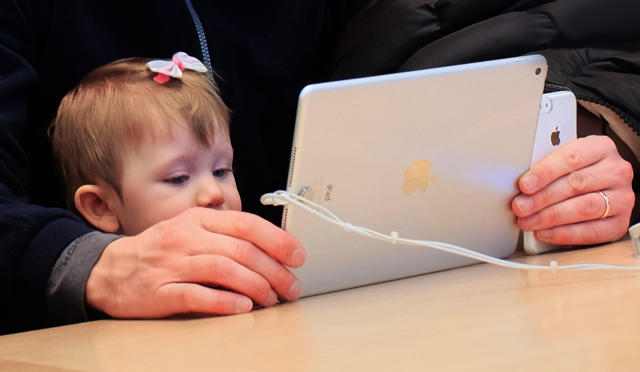
MEDIA IS JUST ANOTHER ENVIRONMENT. CHILDREN DO THE SAME THINGS THEY HAVE ALWAYS DONE, ONLY VIRTUALLY.
In other words, the digital world is just an extension of the analog world, which means you can hand your kid that smartphone with minimal guilt. However, there are a slew of cautions included with the report. Namely, parents need to still exercise discretion when it comes to the content being consumed. They should keep in mind that children under two don’t seem to absorb information from passive media (like Sesame Street playing on the TV). Engaging in content alongside your child is best—be that playing a two-player game or explaining what they’re watching on TV. And nothing replaces the linguistic teaching power of simple talk time between an adult and an infant or toddler. (Just because the AAP isn't outright banning infants from using screens doesn't mean that scientists are recommending their use.)
Of course, the list just goes on from here, and it’s a must-read, both for parents managing this media, and designers who create apps and media for children.
But the biggest takeaway that screens are okay for little kids is exciting, and could open the doors for more innovation in an increasingly app-based world. (Leapfrog, notably, has never designed screen-based experiences for children under 18 months.) For those awaiting even more details, the AAP will be releasing their full, formal recommendations on the topic some time before the 2016 AAP National Conference & Exhibition.
JOIN SL 2.0
SUBSCRIBE TO
SCHOOL LEADERSHIP 2.0
Feedspot named School Leadership 2.0 one of the "Top 25 Educational Leadership Blogs"
"School Leadership 2.0 is the premier virtual learning community for school leaders from around the globe."
---------------------------
Our community is a subscription-based paid service ($19.95/year or only $1.99 per month for a trial membership) that will provide school leaders with outstanding resources. Learn more about membership to this service by clicking one of our links below.
Click HERE to subscribe as an individual.
Click HERE to learn about group membership (i.e., association, leadership teams)
__________________
CREATE AN EMPLOYER PROFILE AND GET JOB ALERTS AT
SCHOOLLEADERSHIPJOBS.COM
New Partnership
Mentors.net - a Professional Development Resource
Mentors.net was founded in 1995 as a professional development resource for school administrators leading new teacher induction programs. It soon evolved into a destination where both new and student teachers could reflect on their teaching experiences. Now, nearly thirty years later, Mentors.net has taken on a new direction—serving as a platform for beginning teachers, preservice educators, and
other professionals to share their insights and experiences from the early years of teaching, with a focus on integrating artificial intelligence. We invite you to contribute by sharing your experiences in the form of a journal article, story, reflection, or timely tips, especially on how you incorporate AI into your teaching
practice. Submissions may range from a 500-word personal reflection to a 2,000-word article with formal citations. Click here to explore and contribute an article.
Also, consider the exciting learning opportunity offered through the Mentors.net AI Academy.
© 2026 Created by William Brennan and Michael Keany
Powered by

