School Leadership 2.0
A Network Connecting School Leaders From Around The Globe
See The Story Of Income Inequality In Photos Of People's Household Possessions
See The Story Of Income Inequality In Photos Of People's Household Possessions
Toothbrushes, nice shoes, kids toys: When you see the difference in how families around the world live with their objects, you see global poverty in a new light.
What's it like to live on $10 a week? Or $100, or $1,000? A new photo collection makes the answer less abstract than usual: Instead of focusing on data, it tells the story of income inequality through everyday objects.
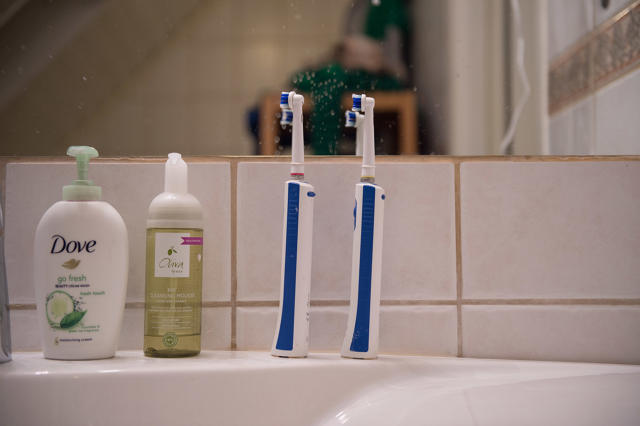
Take a toothbrush. Ask someone living on a dollar or two a day in rural India how they brush their teeth, and they might hold up a finger. Others might use a twig. For those with a little more money, a family might share one old toothbrush. At the other end of the spectrum, every family member might have an electric toothbrush—maybe even in their own bathroom.
It's a simple way to imagine living a completely different life. A new website called Dollar Street, set to launch early in 2016, lays out homes from around the world in a series—poorest on the left, richest on right—and then shows what's inside each house, from shoes to dish racks to toys.

"The current way of communicating poverty, which is very often kids crying or 'catastrophe imagery,' sort of implies a moral standard," says Anna Rosling-Rönnlund, project manager for Dollar Street. "When you see it you know you're supposed to act in some way—donate some money or change how you eat or something. I felt that it was a way of communicating that excludes the pure understanding of something. You have these moral layers on it which I think makes it harder for many people to really understand what the world is like."
Rosling-Rönnlund, who trained as a photographer, first started thinking about the idea as a co-founder of the Gapminder Foundation, which uses graphic charts to present data about the world. "A lot of people are still hesitant to look at statistics," she says. "A colorful chart is still a chart."
A chart also can't tell the same story as a photograph. "I remember looking at one of the household surveys that World Bank produced, and it was saying this many people in an age group have an 'improved pit latrine,'" she says. "I started thinking, I understand the numbers, but do I really know what a pit latrine is? Being a photographer, I thought, why not take a picture of it instead?"
So far, the project has photographed the objects in over 200 homes, in 48 countries. Each photographer aims to capture 135 different items. "We wanted to have everyday functions everybody does," Rosling-Rönnlund says. Like a stove—it doesn't matter what income you have, somehow you're going to prepare food in some way. And a toilet, and shower, and soap, and the bed."
Most of the photos don't include people, so it's easier for the viewer to imagine actually using the objects themselves. "Every time you see a home from a poor country, most often you see like the whole family standing in front of the house, and you get so distracted by seeing all those people it can be tricky to understand what life is really like for them," she says.
Eventually, she hopes that the site will become a standard tool in classrooms. "The whole idea is to moderate a baseline imagery that can work in parallel with a world map, being a reference so that you understand what the world looks like on a broad scale," she says.
JOIN SL 2.0
SUBSCRIBE TO
SCHOOL LEADERSHIP 2.0
Feedspot named School Leadership 2.0 one of the "Top 25 Educational Leadership Blogs"
"School Leadership 2.0 is the premier virtual learning community for school leaders from around the globe."
---------------------------
Our community is a subscription-based paid service ($19.95/year or only $1.99 per month for a trial membership) that will provide school leaders with outstanding resources. Learn more about membership to this service by clicking one of our links below.
Click HERE to subscribe as an individual.
Click HERE to learn about group membership (i.e., association, leadership teams)
__________________
CREATE AN EMPLOYER PROFILE AND GET JOB ALERTS AT
SCHOOLLEADERSHIPJOBS.COM
New Partnership
Mentors.net - a Professional Development Resource
Mentors.net was founded in 1995 as a professional development resource for school administrators leading new teacher induction programs. It soon evolved into a destination where both new and student teachers could reflect on their teaching experiences. Now, nearly thirty years later, Mentors.net has taken on a new direction—serving as a platform for beginning teachers, preservice educators, and
other professionals to share their insights and experiences from the early years of teaching, with a focus on integrating artificial intelligence. We invite you to contribute by sharing your experiences in the form of a journal article, story, reflection, or timely tips, especially on how you incorporate AI into your teaching
practice. Submissions may range from a 500-word personal reflection to a 2,000-word article with formal citations. Click here to explore and contribute an article.
Also, consider the exciting learning opportunity offered through the Mentors.net AI Academy.
© 2026 Created by William Brennan and Michael Keany
Powered by

