School Leadership 2.0
A Network Connecting School Leaders From Around The Globe
Preschool, A State-By-State Update - More states than ever are providing publicly funded preschool
Preschool, A State-By-State Update


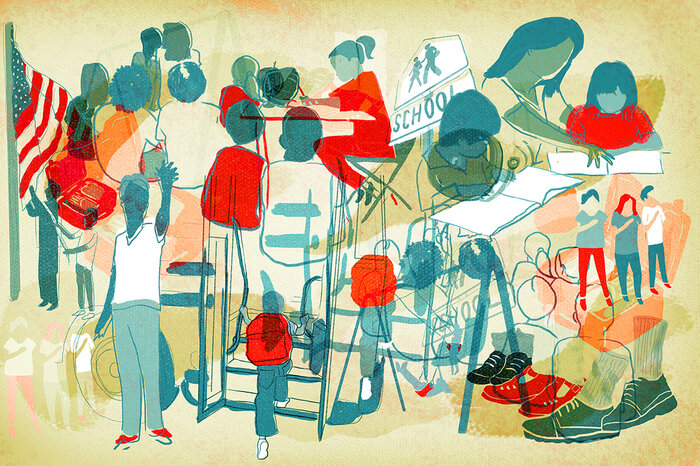
More states than ever are providing publicly funded preschool. That's according to a new report from the researchers at the National Institute for Early Education Research, or NIEER, who have been tracking state preschool policies and programs since 2002.
In 2016, the report found, 43 states, plus the District of Columbia and Guam, provide publicly funded preschool. They serve about 1.5 million children across the country — mostly 3- and 4-year-olds. Total state spending on preschool is now about $7.4 billion, an eight percent increase over last year. That increase has pushed spending to nearly $5,000 per child.
Last year 24 states increased spending per child. California and Texas saw some of the biggest increases.
Preschool got a pig push under the Obama Administration — and the federal preschool development grants that totaled $210 million last year were a big help.
Steve Barnett, head of NIEER, says the numbers are encouraging, but he cautions that the quality of most preschool programs is still very uneven.
"The growing inequality between states that have moved ahead and invested in quality preschool programs and states that have done nothing is really stark."
Barnett says the reasons for that vary. Funding is a good example.
Washington, D.C., spends $15,748 per child. Mississippi spends less than $2,000 per child, roughly half of what states spend on average.
The disparities in enrollment are pretty pronounced as well.
Florida, Oklahoma, Wisconsin and the District of Columbia each serve more than 70 percent of their 4-year-olds. Another 18 states serve more than a third of these kids (New York City is considering universal preschool for 3-year-olds as well).
Seven states, NIEER says, don't fund preschool at all.
With the funding issue comes the perennial question: Is the investment justified by the results?
The growing consensus among researchers, including folks at NIEER, is that the highest-quality programs are well-funded. The poorest-quality programs, surprise surprise, are not. But the support for preschool funding often depends on whether programs target low-income kids or middle-income children — often called "universal" programs.
"The difference between universal and targeted [programs] is the difference between public education and charity," says Barnett. "Should [preschool] be segregated by income?"
The NIEER report doesn't really get into that question, but previous research suggests that state lawmakers are more likely to fund and expand preschool programs if they benefit moderate- to middle-income families, and not just the poor.
Barnett says he worries about programs that fall short of the quality standards NIEER has set for all kids — regardless of income.
"If you have large classes with teachers who really don't know child development or how to teach, this can be very stressful for kids," he says.
The good news, says Barnett, is that state-funded preschool programs are better today than they were just 10 years ago. Quality has improved in states like Alabama, North Carolina, Rhode Island and West Virginia, in large part because they've invested in smaller class sizes and quality teachers.
JOIN SL 2.0
SUBSCRIBE TO
SCHOOL LEADERSHIP 2.0
Feedspot named School Leadership 2.0 one of the "Top 25 Educational Leadership Blogs"
"School Leadership 2.0 is the premier virtual learning community for school leaders from around the globe."
---------------------------
Our community is a subscription-based paid service ($19.95/year or only $1.99 per month for a trial membership) that will provide school leaders with outstanding resources. Learn more about membership to this service by clicking one of our links below.
Click HERE to subscribe as an individual.
Click HERE to learn about group membership (i.e., association, leadership teams)
__________________
CREATE AN EMPLOYER PROFILE AND GET JOB ALERTS AT
SCHOOLLEADERSHIPJOBS.COM
New Partnership
Mentors.net - a Professional Development Resource
Mentors.net was founded in 1995 as a professional development resource for school administrators leading new teacher induction programs. It soon evolved into a destination where both new and student teachers could reflect on their teaching experiences. Now, nearly thirty years later, Mentors.net has taken on a new direction—serving as a platform for beginning teachers, preservice educators, and
other professionals to share their insights and experiences from the early years of teaching, with a focus on integrating artificial intelligence. We invite you to contribute by sharing your experiences in the form of a journal article, story, reflection, or timely tips, especially on how you incorporate AI into your teaching
practice. Submissions may range from a 500-word personal reflection to a 2,000-word article with formal citations. Click here to explore and contribute an article.
Also, consider the exciting learning opportunity offered through the Mentors.net AI Academy.
© 2026 Created by William Brennan and Michael Keany
Powered by

