Self-Regulation and the Common Core: Application to the ELA Standards
By Marie C. White and Maria K. DiBenedetto
(Routledge/Eye on Education, 2015 – Learn more)
 Reviewed by Linda Biondi
Before you think about reading this book, you need to step back, take a breath, and realize you cannot do it all. Self Regulation and the Common Core: Application to the ELA Standards is a book that needs to be read in small doses or you will feel exhausted just thinking about implementation many of the great ideas from White and DiBenedetto.
 Self Regulation and the Common Core: Application to the ELA Standards is a book that you read, pause, reflect, and take action. It is not a book that idealizes the Common Core but invites the teacher to further explore the Standards to see how they can promote student success.
The authors have built a toolbox of strategies that students can use to become self-regulated learners. An important thought prevailed throughout the book: it’s not sufficient for teachers to provide students with strategies to become self-regulated learners without giving them guidelines and opportunities to engage in self-assessment.
This research-based book highlights the fact that students who are able to self regulate have a positive outlook on learning and practice self-efficacy. This in turn creates self-regulated adults who succeed in college and careers. After reading a few chapters of the book, I realized I needed to pause and reflect on the authors’ message and analyze my strengths and weaknesses as a self-regulated teacher.
Peeling back the layers of self-regulation
This innovative book made me reflect about the students in my class. I began to wonder about our goal setting. We always set goals. I wondered how effective their goal setting was. Did I give them ample time to reflect periodically about their goals? Did they modify their goals to meet their strengths and weaknesses? Were they becoming self-regulated learners?
I realized what a difficult task I was asking of my fourth graders. Self-regulated learning, according to White and DiBenedetto, is not solely posting a chart in the room indicating what to do when your work is completed.
Our students don’t come into our classroom innately knowing how to set goals and how to measure their progress. Our students walk into the classroom with different levels of skills, desire, backgrounds, cultures, value, behaviors. As teachers, we need to set the environment in such a way that our students can plan, monitor and assess their learning. To have a self-regulated classroom, you need to become a self-regulated teacher. I wondered if I was I meeting that definition and set out to see.
The self-regulated teacher
I began by analyzing the definition of the self-regulated teacher. In order to teach this, I needed to model it. The authors very succinctly describe a self-regulated teacher: someone who focuses on their own self-regulated learning (SRL) skills and is aware of their own teaching practices. Yes, I was a self-regulated teacher, but with some serious work to do.
- The teacher self-monitors during instruction.
- The teacher is a model for self-regulation.
- The teacher has high self-efficacy.
- The teacher builds self-efficacy in students.
- The teacher gives choices.
- The teacher knows that SRL is a process, teaching students how to learn, and is a long-term process.
- The teacher is an agent of change.
- The teacher sets realistic and attainable goals.
- The teacher encourages help seeking.
The book assists educators in effectively integrating self-regulated learning into their teaching repertoire. For the educator who is overwhelmed with where to begin, don’t stress! The book is divided into three developmentally appropriate sections: elementary school, middle school and high school. Although my primary focus was that of a fourth grade teacher, I found that reading the second/third and fifth/sixth grade sections helped clarify several thoughts and I was able to glean some additional ideas from each section.
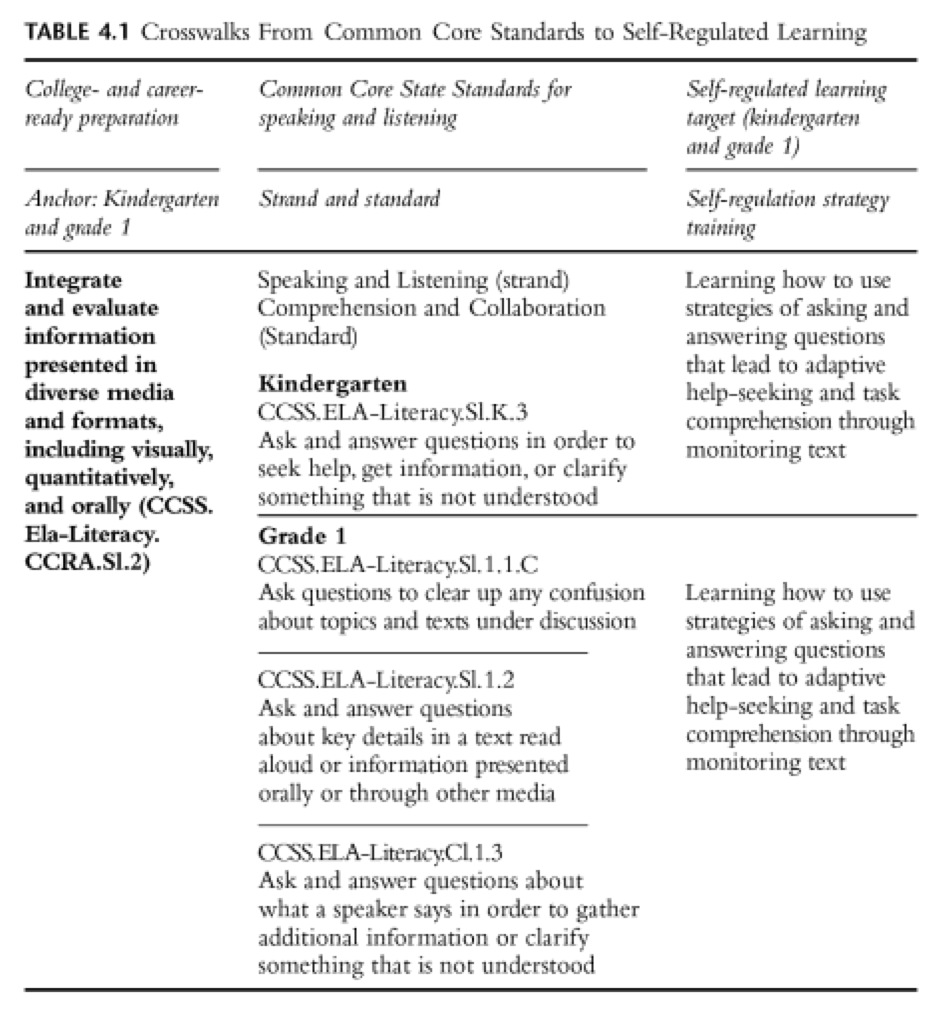
Crosswalks from CCSS to self-regulated learning
What is equally beneficial are the “Crosswalks” from the Common Core to Self-Regulated Learning. The Common Core encourages “student centered learning though critical thinking, problem solving, cooperation, and individual achievement.” (p. 6) Self-regulated learning doesn’t begin in the middle grades but at the primary level (see Table 4.1 here).
So much of what I read seemed to be common sense. If we provide a supportive classroom where listening and speaking experiences are provided with rich, quality literature and opportunities for exploring language, our students will experience success then and as they grow older.
I was impressed with the quality of the writing and with how each section focused on developmentally appropriate goals and activities. For example, the primary concentration of the fourth and fifth grade section was “inferring meaning from context and morpheme clues.” I felt as if the authors were reading my mind.
Using academic language in student writing
The Common Core standards require our students to use appropriate academic language in their writing. “Academic language is the language needed to succeed in school, and it is often cited as one of the key factors affecting the achievement gap that exists between high-and low-performing students in our schools.” (p. 112) To use an old expression, “They hit the nail on the head!” Teachers, no matter what grade level you teach, you will be able to easily adapt the authors’ framework, ideas, tips, and examples.
An accessible book for veterans and beginners
Who doesn’t want their students to succeed? What teacher doesn’t want students who are able to take responsibility for their own learning? I loved the professional conversational tone of the book, mixed with the realistic applications to use in the classroom. This book is accessible to teachers just beginning their teaching journey and to veterans who might need a few more ideas or reaffirmation of their practice.
I enjoyed this book because it combined the Common Core Standards with self-regulation that helps student transfer skills beyond the classroom. If you want your students to believe in their own ability to learn, take responsibility for their own learning, and develop a sense of autonomy, then this is the book for you.
Linda Biondi is a fourth grade teacher at Pond Road Middle School in Robbinsville, NJ, and a long-time Morning Meeting practitioner. She’s also the recipient of several educational grants, a Teacher Consultant with the National Writing Project and a participant on the NJ Department of Education Teacher Advisory Panel. Linda participates in ECET2 Celebrate Teaching which has posted an interview with her.

