School Leadership 2.0
A Network Connecting School Leaders From Around The Globe
Mapping The Ever-Increasing Divide Between America's Rich And Poor by Ben Schiller
Mapping The Ever-Increasing Divide Between America's Rich And Poor
The rich and poor are living further and further apart. These segregated enclaves mask how people perceive inequality and reduce the chance they will overcome it.
Fast Company
In the last two decades, the United States has not only become a more unequal place, it's also become a place where the richest and poorest live further apart. It's a nation with growing inequality in geography as much as actual income and wealth.
You can see as much from the map accompanying a new report from the Urban Institute. It shows how the top and bottom 10% of neighborhoods, measured by income, education, home ownership and home values, are distributed in commuter zones across the country.
The report tracks changes between 1990 and 2010. Out of 570 commuting zones, inequality grew in 433. In more than half of those, income inequality grew mostly because of increases at the top-end, rather than decreases at the bottom. Washington, D.C. is notable in this regard. It saw its purchasing power rise $43,000 among its richest tracts while its most disadvantaged areas saw incomes rise only $3,100. The D.C. area also has the three most advantaged neighborhoods in the country: Chevy Chase, in Maryland, where incomes average $466,000 a year, and two in nearby Bethesda. The least advantaged areas are in Columbus, Ohio, and Memphis, Tennessee.
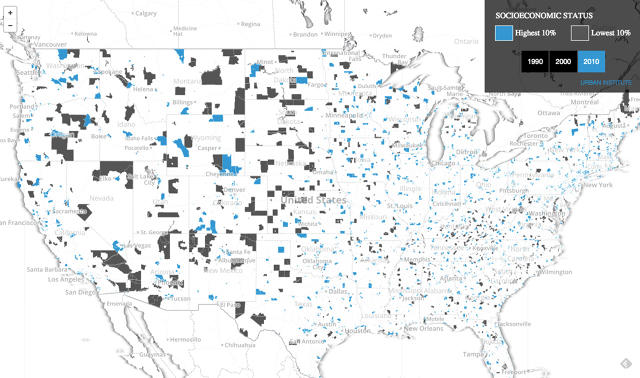
"All over the United States since 1990, affluent households have moved into new areas at the urban fringe of major cities. Over the past two decades, these top and bottom tracts have grown far apart both physically and economically," the report, written by Rolf Pendall and Carl Hedman, says.
The way people of similar socioeconomic backgrounds congregate together exacerbates differences between rich and poor and decreases mobility, the authors say. In general, clustering is greatest in the suburbs, with the most distressed areas within dense urban neighborhoods or low-density rural districts. The greatest differences between rich and poor are in cities of five to 10 million people, while the smallest differences are in cities of less than 100,000 people.
Pendall and Hedman say cities can reduce geographic inequality by encouraging mixed-income neighborhoods in central areas and suburbs, by limiting "new isolated enclaves of privilege, especially in regions whose populations are declining," and by simply investing more resources in the nation's poorest places. Without such policies, we may see not only widening inequality, but also growing differences in the experience of living in this country.
[Cover Photo: Slobo/Getty Images]

JOIN SL 2.0
SUBSCRIBE TO
SCHOOL LEADERSHIP 2.0
Feedspot named School Leadership 2.0 one of the "Top 25 Educational Leadership Blogs"
"School Leadership 2.0 is the premier virtual learning community for school leaders from around the globe."
---------------------------
Our community is a subscription-based paid service ($19.95/year or only $1.99 per month for a trial membership) that will provide school leaders with outstanding resources. Learn more about membership to this service by clicking one of our links below.
Click HERE to subscribe as an individual.
Click HERE to learn about group membership (i.e., association, leadership teams)
__________________
CREATE AN EMPLOYER PROFILE AND GET JOB ALERTS AT
SCHOOLLEADERSHIPJOBS.COM
New Partnership
Mentors.net - a Professional Development Resource
Mentors.net was founded in 1995 as a professional development resource for school administrators leading new teacher induction programs. It soon evolved into a destination where both new and student teachers could reflect on their teaching experiences. Now, nearly thirty years later, Mentors.net has taken on a new direction—serving as a platform for beginning teachers, preservice educators, and
other professionals to share their insights and experiences from the early years of teaching, with a focus on integrating artificial intelligence. We invite you to contribute by sharing your experiences in the form of a journal article, story, reflection, or timely tips, especially on how you incorporate AI into your teaching
practice. Submissions may range from a 500-word personal reflection to a 2,000-word article with formal citations. Click here to explore and contribute an article.
Also, consider the exciting learning opportunity offered through the Mentors.net AI Academy.
© 2026 Created by William Brennan and Michael Keany
Powered by

