School Leadership 2.0
A Network Connecting School Leaders From Around The Globe
Improving School Board Effectiveness: A Balanced Governance Approach
Improving School Board Effectiveness: A Balanced Governance Approach
reviewed by Robert G. Smith — October 20, 2016
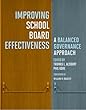 Title: Improving School Board Effectiveness: A Balanced Governance Approach
Author(s): Thomas L. Alsbury and Phil Gore (Eds.)
Publisher: Harvard Education Press, Cambridge
ISBN: 1612508766, Pages: 205, Year: 2015
Search for book at Amazon.com
Thomas L. Alsbury and Phil Gore assembled an edited work that will be of value to scholars and school and community leaders concerned with improving the governance of their American school districts. In Improving School Board Effectiveness: A Balanced Governance Approach, the authors describe balanced governance; depict findings from research conducted regarding effective governance; provide tools designed to assess the work of school boards, school board members, and superintendents; and portray recommended practices illustrative of balanced governance and how to develop it.
The school districts of interest in this book represent the vast majority of the nearly 13,500 school systems across the United States (Snyder, de Brey, & Dillow, 2016) governed by boards elected by the voters of a school district. This is opposed to those led by appointed boards or controlled by mayors. The balance in balanced school board governance refers to locating the Aristotelian mean in board behaviors. Specifically, it is finding a balance between a laissez-faire stance where the boards hire superintendents and allow them to work free of board oversight versus a stance characterized by heavy-handed meddling in all phases of governance and operations. Boards following balanced governance are clear about their policies, particularly those related to student learning and ethics, but resist prescribing the details of administrative behaviors among other things. They generate and follow policies and plans designed to hold superintendents accountable for accomplishing desired ends, yet work collaboratively with them and refrain from interfering in the operations of the schools. Finally, they represent the goals of their communities but forgo acting as the agents or minions of special interests.
As a former superintendent of schools (Arlington, VA, 1997–2009), I believe that the board with which I worked would have found this conceptual framework and the chapters describing governance procedures and board development within this book instructive. Upon becoming superintendent in Arlington, I explored two overflowing large notebooks full of documents called the Arlington School Directives, all of which had been debated and adopted by the school board. They featured an awkward admixture of policies and highly detailed regulations and procedures that most students of school governance would have found to be the province of school administrators. After the board and I worked through a book study of Boards that Make a Differenceby John Carver (1997), we agreed to launch an effort to disband the Arlington School Directives, replace them with policies approved by the board, and separate implementing procedures developed and approved by the district administration. Although we drafted new policies and separated them from procedures, we never quite implemented Carver’s proposed conception of policy governance. He outlined an approach to policymaking in which the board specified ends but not means. In Carver's words:
To address the acceptability of means, the board need only define the boundaries of acceptability. The board limits the superintendent's latitude regarding certain situations, activities, or risk. In effect, the board does not tell the system how to operate, but how not to—an approach that is simpler and safer for the board and freeing for the staff. The message from board to superintendent, then, is, "Achieve these ends within these restrictions on means." This instruction embraces the whole of board-staff delegation, which is to say, the superintendent's job description. (Carver, 2000, p. 28)
The board members with whom I worked had difficulty with this concept and essentially abandoned it early in the process of policy development when they tried to write a policy describing their expectations of my role; they could not bring themselves to simply proscribe the behaviors they would not countenance rather than prescribe what I must do. However, the board did disband its focus on prescribing all of the detailed implementing procedures on which it had previously voted.
The descriptions of balanced governance in this book appear to vary from Carver’s approach to policy making and come closer to the posture ultimately adopted by the Arlington board. At the same time, balanced governance seems to share a number of Carver’s prescriptions, including representing the owners (the public), clearly specifying the ends sought in student and system performance, and evaluating the superintendent in accomplishing those ends.
The board with which I worked would have benefitted from reading and learning from Improving School Board Effectiveness, particularly the chapters describing the efforts of the Iowa Association of School Boards on board development based on its Lighthouse studies, the Panasonic Foundation’s work with urban school boards, and the board development work of the Massachusetts District Governance Support Project.
The authors of these chapters and almost all of the contributors to this book relied on conclusions from a few research projects finding that school board behaviors exert an impact on student learning that is either positive or negative. They concluded that boards exhibiting the behaviors favored in these descriptions would produce more positive effects than ones acting in contravention to preferred balanced governance procedures (Land, 2002; Petersen, 2000; Shober & Hartney, 2014).
The conclusion that school boards can make a difference appears reasonable, particularly if they are dysfunctional. Less convincing are the assertions that particular behaviors by school boards produce particular results in student learning. Most of the studies were conducted in a few districts, failed to link specific board behaviors to specific student outcomes, elided relationships between student characteristics and achievement across districts, and tended not to consider competing hypotheses regarding results. Yet despite the difficulty in establishing causal links between board governance and student achievement, multiple studies across individual districts and states using methodologies like case studies and analyses of student achievement replicate findings lending credence to the contention that many of the board behaviors that the editors considered balanced may be associated with greater student learning.
I wish the editors and contributors had been more nuanced in their description of findings and given consideration to next steps needed in studying the relationship between school board governance and student performance. Nevertheless, Improving School Board Effectiveness shines a light on the importance of paying attention to how school districts govern. It also makes a significant contribution to our understanding of the governance process.
References
Carver, J. (1997). Boards that make a difference: A new design for leadership in nonprofit and public organizations (2nd ed.). San Francisco, CA: Jossey-Bass.
Carver, J. (2000). Remaking governance. American School Board Journal, 187(3), 26–30.
Land, D. (2002). Local school boards under review: Their role and effectiveness in relation to students' academic achievement. Review of Educational Research, 72(2), 229–278.
Petersen, S. (2000). Board of education involvement in school decisions and student achievement.Public Administration Quarterly, 24(1), 46–68.
Shober, A. F., & Hartney, M. T. (2014, March 25). Does school board leadership matter? Thomas B. Fordham Institute. Retrieved from https://edexcellence.net/publications/does-school-board-leadership-...
Snyder, T. D., de Brey, C., & Dillow, S. A. (2016). Digest of education statistics 2014 (NCES
2016-006). Washington, D.C.: National Center for Education Statistics, Institute of Education Sciences, U.S. Department of Education. Retrieved from http://nces.ed.gov/pubs2016/2016006.pdf
| Cite This Article as: Teachers College Record, Date Published: October 20, 2016 http://www.tcrecord.org ID Number: 21687 |
JOIN SL 2.0
SUBSCRIBE TO
SCHOOL LEADERSHIP 2.0
Feedspot named School Leadership 2.0 one of the "Top 25 Educational Leadership Blogs"
"School Leadership 2.0 is the premier virtual learning community for school leaders from around the globe."
---------------------------
Our community is a subscription-based paid service ($19.95/year or only $1.99 per month for a trial membership) that will provide school leaders with outstanding resources. Learn more about membership to this service by clicking one of our links below.
Click HERE to subscribe as an individual.
Click HERE to learn about group membership (i.e., association, leadership teams)
__________________
CREATE AN EMPLOYER PROFILE AND GET JOB ALERTS AT
SCHOOLLEADERSHIPJOBS.COM
New Partnership
Mentors.net - a Professional Development Resource
Mentors.net was founded in 1995 as a professional development resource for school administrators leading new teacher induction programs. It soon evolved into a destination where both new and student teachers could reflect on their teaching experiences. Now, nearly thirty years later, Mentors.net has taken on a new direction—serving as a platform for beginning teachers, preservice educators, and
other professionals to share their insights and experiences from the early years of teaching, with a focus on integrating artificial intelligence. We invite you to contribute by sharing your experiences in the form of a journal article, story, reflection, or timely tips, especially on how you incorporate AI into your teaching
practice. Submissions may range from a 500-word personal reflection to a 2,000-word article with formal citations. Click here to explore and contribute an article.
Also, consider the exciting learning opportunity offered through the Mentors.net AI Academy.
© 2026 Created by William Brennan and Michael Keany
Powered by

