School Leadership 2.0
A Network Connecting School Leaders From Around The Globe
Google’s WorldSense Will Free VR From The PC And Smartphone This Year
Google’s WorldSense Will Free VR From The PC And Smartphone This Year
New headsets from HTC and Lenovo, incorporating technology from Google’s Daydream and Tango, will usher in the era of stand-alone VR.
Google’s announcement yesterday that it is working with two partners on the creation of stand-alone virtual-re... that require neither being connected to a smartphone nor being tethered to a PC means that the next generation of consumer VR is coming no later than year’s end. It’s also the latest example of one company designing the software behind VR headsets and then turning those designs over to outside hardware manufacturers to build consumer devices.
Virtual reality is expected to be a $38 billion industry by 2026, according to Greenlight Insights. Currently, there are effectively four levels of consumer VR, all of which require an external computing device, and which range in price from $15 to $800:
- Google Cardboard, on the low end, works with iPhone or Android
- Mobile VR headsets, like Samsung’s Gear VR (powered by software developed by Facebook-owned Oculus) and Google’s Daydream View, both of which work only with Android phones
- Sony’s PlayStation VR, which works with the PlayStation 4
- On the high end, the Oculus Rift and HTC Vive, both of which must be tethered to a gaming-quality PC
It’s not known exactly what the new standalone VR devices–which will be manufactured initially by HTC’s Vive division and Lenovo using a reference design from Google and based on Qualcomm’s Snapdragon 835 chipset–will cost. But Clay Bavor, Google’s VP of VR and AR, said they will likely be around the same as “desktop devices,” meaning the $599 Rift from Facebook-owned Oculus or the $799 Vive, both of which also require a pricey, powerful PC.
The precise timetable for these Google-powered stand-alone VR headsets also remains unknown, but the company says they will both go on sale by year’s end. Oculus is also developing a stand-alone headset, which it has code-named Santa Cruz. It’s not yet known how much that device will cost, or when it will be available.
The new Google software for standalone headsets is the culmination of several years’ work by people on the teams of both Google’s Daydream and Tango–its augmented reality platform. In essence, Bavor said at a press briefing, the project connects dots between Daydream and Tango. It does so by combining what Google has already built in virtual reality–a lightweight, easy-to-use VR system–with Tango’s ability to see and map three-dimensional space.
The result is a Daydream-ready VR headset that offers positional tracking, meaning that users can physically move around in virtual environments rather than simply being in the center of a 360-degree scene. Low-end and mobile VR systems like Cardboard, Gear VR, and Daydream View offer the latter, while the PlayStation VR, Rift, and Vive offer the former. Oculus’s Santa Cruz prototype also includes positional tracking.
The new devices will run all existing Daydream apps–of which there are currently about 150–while new apps that are built for WorldSense will not work on existing Daydream-ready headsets.
Google’s Tango, which is now available on devices such as the Lenovo Phab 2 Pro and Asus ZenPhone AR, uses internal sensors to map out 3D space. That technology is at the heart of the new stand-alone VR headsets. But they’ll utilize a new implementation of that technology, known as WorldSense, that will enable the positional tracking. It uses two cameras built into the headset, rather than the single camera that powers Tango devices.
Google also unveiled a new tool for Daydream, known as Seurat–named for the French painter–that should be quite popular with developers of graphics-intensive content. Seurat was designed to make it possible to run cinematic-quality computer-generated content on the new positional-tracking headsets, allowing users the freedom of movement within scenes that are powered by WorldSense.
As an example of that, Google is showing a short demo based on Rogue One, the recent Star Wars spin-off. In the demo, which utilizes millions of polygons provided by Lucasfilm’s ILMxLab, users can walk around a spaceship bay with robots wandering by, with real-time reflections on the polished floor looking just as they would in real life.
Seurat supports content created in professional-strength graphics tools such as Maya and game engines like Unity, meaning there’s a wide variety of potential implementations of the tool. Google says it will start out with content provided by partners like ILMxLab, but will eventually expand beyond that.
THE PARTNER APPROACH
Companies that develop VR headsets have chosen two models of blending software with hardware. On the one hand, there are devices where both are made by the same company–think the Oculus Rift, PlayStation VR, and even Google’s own Daydream View headset.
But Bavor said that the View was meant more to help jumpstart the Daydream developer ecosystem than to signal that Google wants to be a major player in VR hardware manufacturing.
That’s why the company has no plans to make a stand-alone headset itself, and will instead turn to partners like HTC and Lenovo. Similarly, Oculus developed the software that powers Samsung’s mobile Gear VR headset, while Valve designed the system used by HTC’s Vive.
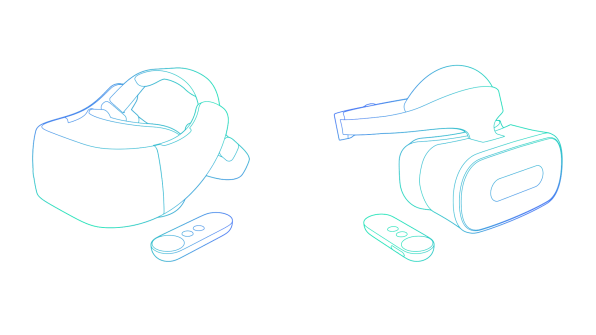 The Vive standalone headset with Daydream and the Lenovo standalone headset with Daydream. [Image: Google]
It’s not yet clear whether one model has more potential for long-term success than the other, but Google is clearly betting on the partner approach. Oculus, on the other hand, is playing both sides–with the Rift, it developed the software and the hardware, while it crafted only the software on Samsung’s Gear VR.
For now, it’s also far too early to know how stand-alone devices like those Google has announced, or Santa Cruz, will do. Though they don’t require being tethered to a PC, they will still likely be expensive.
But they do offer one other big advantage compared to every other existing VR system except Google’s own bare-bones Cardboard–they don’t need a Windows PC or an Android phone. In other words, Apple fans won’t be shut out of the world of VR as they largely are today.
“Turns out a lot of people have iPhones,” Bavor said.
JOIN SL 2.0
SUBSCRIBE TO
SCHOOL LEADERSHIP 2.0
Feedspot named School Leadership 2.0 one of the "Top 25 Educational Leadership Blogs"
"School Leadership 2.0 is the premier virtual learning community for school leaders from around the globe."
---------------------------
Our community is a subscription-based paid service ($19.95/year or only $1.99 per month for a trial membership) that will provide school leaders with outstanding resources. Learn more about membership to this service by clicking one of our links below.
Click HERE to subscribe as an individual.
Click HERE to learn about group membership (i.e., association, leadership teams)
__________________
CREATE AN EMPLOYER PROFILE AND GET JOB ALERTS AT
SCHOOLLEADERSHIPJOBS.COM
New Partnership
Mentors.net - a Professional Development Resource
Mentors.net was founded in 1995 as a professional development resource for school administrators leading new teacher induction programs. It soon evolved into a destination where both new and student teachers could reflect on their teaching experiences. Now, nearly thirty years later, Mentors.net has taken on a new direction—serving as a platform for beginning teachers, preservice educators, and
other professionals to share their insights and experiences from the early years of teaching, with a focus on integrating artificial intelligence. We invite you to contribute by sharing your experiences in the form of a journal article, story, reflection, or timely tips, especially on how you incorporate AI into your teaching
practice. Submissions may range from a 500-word personal reflection to a 2,000-word article with formal citations. Click here to explore and contribute an article.
Also, consider the exciting learning opportunity offered through the Mentors.net AI Academy.
© 2026 Created by William Brennan and Michael Keany
Powered by

