School Leadership 2.0
A Network Connecting School Leaders From Around The Globe
Getting at the Core of the Common Core with Social Studies reviewed by Jason Harshman
Getting at the Core of the Common Core with Social Studies
reviewed by Jason Harshman — February 02, 2016
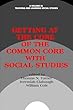 Title: Getting at the Core of the Common Core with Social Studies
Author(s): Thomas N. Turner, Jeremiah Clabough, William Cole (Eds.)
Publisher: Information Age Publishing, Charlotte
ISBN: 1623968747, Pages: 306, Year: 2014
Search for book at Amazon.com
This edited book provides insightful and creative classroom-ready strategies for social studies instruction while incorporating the Common Core State Standards (CCSS) and learning objectives. Readers will appreciate the literature the authors draw on to illustrate how social studies educators have blended content, literacy skills, and text-based arguments in history, geography, civics, and economics. Chapters about elementary grade-level topics provide examples of high quality activities that are possible even in schools that are cutting instructional time for social studies. The authors discuss how coupling social studies with CCSS facilitates teaching digital literacy, reading as a historian, and thinking critically. Practitioner-accessible chapters round out the book with topics on: reaching students with learning disabilities, promoting inquiry, and developing historical thinking skills. All of this is done with a tone that is intentionally non-combative, and the authors hope will present “the CCSS as opportunity rather than doom” (p. 3) for social studies educators.
This book’s strengths include detailed chapters on lesson planning and instructional activities that develop literacy skills and achieve Common Core goals. Following a brief discussion of relevant literature, the authors provide procedures for student-centered activities, including graphic organizers, question prompts for handouts, and lesson resources. Chapter Ten, “Historical Fiction: Reality Meets Imagination,” includes guidelines for choosing historical fiction books recommended by Levstik and Barton (2011), and identifies a list of high quality resources and relevant Common Core standards (p. 142). It also contains graphic organizers that students can use to analyze sources, evaluate an author’s argument, and develop historical thinking skills. Chapter Eleven, “Disciplinary Literacy,” similarly provides suggestions for facilitating close reading exercises, and includes a lesson on analyzing the U.S. Constitution to “build students’ understanding of how and why historical texts were constructed for specific purposes” (p. 162).
Discipline-specific chapters such as “Connecting the Economic Way of Thinking to the Common Core” and “Teaching Geography Education within a Common Core Framework” discuss approaches for making national and global connections. Author Kenneth T. Carano correctly addresses the need to prepare students for “geographically literate citizenship” in an internationally connected society (p. 260). He also analyzes the relationships among geographic literacy, the CCSS, and the National Council for the Social Studies (NCSS) College, Career, and Civic Life C3 Framework (NCSS, 2013). Chapter Six, “Building Global Citizens through the Common Core,” addresses the desire to foster global-mindedness through the CCSS. Elementary teachers will find suggestions for incorporating storytelling to teach justice, citizenship, human rights, globalization, and food insecurity appropriate for K–5 students learning international perspectives although the chapters rely only on resources from the Global North.
Chapter Twelve, “Drama in the Social Studies and Common Core: First the Apple, Then the Core,” creatively weaves together social studies, drama, primary source work, roleplaying, and problem solving to reach Common Core standards through its cross-disciplinary focus. Thomas N. Turner, a co-editor and author, argues that the Common Core aims to involve students in the learning process, and drama is one way to achieve this goal by getting students “excited, motivated, and encouraged to be stakeholders” in their education (p. 167). Turner suggests reenacting the Constitutional Convention as a roleplaying exercise in which students argue from the perspective of historical characters, thus developing skills like point of view analysis and primary source work.
Teachers are encouraged to use the resources and lesson activities in this book with the NCSS publication, because it was designed to align social studies instruction with the CCSS. However, there could be even more discussion about how the skills and concepts discussed in this volume achieve the college and career readiness goals addressed in C3 and CCSS. Nevertheless, emphasizing student-centered learning within each lesson highlights the creative and meaningful nature of social studies in an age of standardization. In sum, educators will find Getting at the Core of the Common Core with Social Studies to be a comprehensive volume that is current and applicable to daily social studies education.
References
Levstik, L. S., & Barton, K. C. (2011). Doing history: Investigating with children in elementary and middle schools (4th ed.). New York, NY: Routledge.
National Council for the Social Studies (2013). Social studies for the next generation: Purposes, practices, and implications of the college, career, and civic life (C3) framework for social studies standards, Silver Spring, MD: NCSS.
| Cite This Article as: Teachers College Record, Date Published: February 02, 2016 http://www.tcrecord.org ID Number: 19379, Date Accessed: 4/22/2016 5:03:10 PM |
JOIN SL 2.0
SUBSCRIBE TO
SCHOOL LEADERSHIP 2.0
Feedspot named School Leadership 2.0 one of the "Top 25 Educational Leadership Blogs"
"School Leadership 2.0 is the premier virtual learning community for school leaders from around the globe."
---------------------------
Our community is a subscription-based paid service ($19.95/year or only $1.99 per month for a trial membership) that will provide school leaders with outstanding resources. Learn more about membership to this service by clicking one of our links below.
Click HERE to subscribe as an individual.
Click HERE to learn about group membership (i.e., association, leadership teams)
__________________
CREATE AN EMPLOYER PROFILE AND GET JOB ALERTS AT
SCHOOLLEADERSHIPJOBS.COM
New Partnership
Mentors.net - a Professional Development Resource
Mentors.net was founded in 1995 as a professional development resource for school administrators leading new teacher induction programs. It soon evolved into a destination where both new and student teachers could reflect on their teaching experiences. Now, nearly thirty years later, Mentors.net has taken on a new direction—serving as a platform for beginning teachers, preservice educators, and
other professionals to share their insights and experiences from the early years of teaching, with a focus on integrating artificial intelligence. We invite you to contribute by sharing your experiences in the form of a journal article, story, reflection, or timely tips, especially on how you incorporate AI into your teaching
practice. Submissions may range from a 500-word personal reflection to a 2,000-word article with formal citations. Click here to explore and contribute an article.
Also, consider the exciting learning opportunity offered through the Mentors.net AI Academy.
© 2026 Created by William Brennan and Michael Keany
Powered by

