A couple of weeks ago, I delivered several presentations to a school district in the mid-west, one of the numerous August back-to-school gigs I’m doing fewer of each year. It was a rewarding day, more so than many. Keeping the attention of hundreds of teachers, just back from vacation, catching up with friends, weighing in the politics of new leadership, and desperately needing to be in their classrooms makes this a pretty tough gig. Not so on this day.
 After a presentations about expanding our notions of literacy, a teacher came up asking, “But what’s to be done about students accessing all the information on the Internet that is simply not true.”
I reminded him that I had just made the point that it isn’t just the Internet we need to be worried about. Then I gave him one of my usual responses,
If I was still teaching history, and my students turned in a paper, they would be waiting for the challenge. It happens every time. It’s part of the ongoing classroom conversation.
Placing a student’s paper on his desk and pointing to one paragraph, I ask, “How do you know that’s true?” If the student can’t answer the question, he’s going to lose points. Even if the paragraph is true, he’s going to lose points. My students would be responsible for their information’s appropriateness and the evidence that supports its appropriateness.
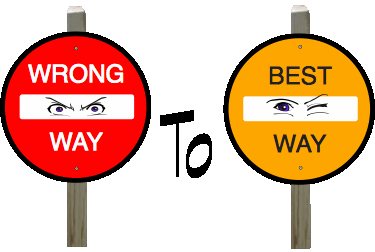
I wonder now if this response makes sense only to me, a figment of a private fantasy. So I thought I’d spend some bits trying to unpack this approach into something that better distinguishes a “new way” from an “old way.“
The difference is in what we call attention to. Our tendency, as teachers, is to address the problem by focusing on the mistakes, red-penning what’s not accurate, not reliable, not valid, doesn’t make sense. It’s logical because whats not true is a fundamental problem to education. We work to keep wrong information out of our textbooks, whiteboards, libraries and lectures. We foster a learning environment where we can all take comfort in the assumption that the information is “true.”
Our position, as teachers, is based on this assumption.
For the problems caused by the Internet, we create checklists to identify the breakage in information.
[ ] Is the author’s name included in the page & can he be contacted?
[ ] Are the author’s qualifications available?
[ ] Is the publisher an educational institution or other reputable organization?
[ ] Is the information fact or opinion? Is there bias?
[ ] Is the URL domain among the trusted (edu, gov, org)?
If you can check all of the above, then you can use the information.
We teach research and writing as a practice in avoiding problems,
..but not as a practice in solving them.
If we teach our learners to research and communicate in order to solve a problem, then we entirely change the approach. We assess their work through conversations about the “best way” rather than the “wrong way,” and learners become active defenders rather than passive accepters of judgement. The classroom conversation changes. Students become more active, empowered and invested. They become stakeholders in their learning, and ultimately, responsible to an authentic context/audience.
They own what they write, present or make, because they did the work and defended it. They’re accountable.
They own the learning.

