School Leadership 2.0
A Network Connecting School Leaders From Around The Globe
Book of the Week: Core Instructional Routines: Go-To Structures for the 6-12 Classroom By Andrea Honigsfeld, Judy Dodge
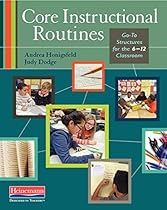 |
Core Instructional Routines: Go-To Structures for the 6-12 Classroom
|
| Click here to learn more or to order at Amazon.com/SL 2.0 discounte... |
How can a secondary teacher reconcile the heavy demands of the content curriculum with best practices while enhancing students' literacy skills in the content areas? Core Instructional Routines helps you build background knowledge and literacy within and across subjects using "SWRL" (Speak, Write, Read, and Listen) routines that make learning more relevant and interactive. Andrea Honigsfeld and Judy Dodge share ample opportunities for creative collaboration, critical analysis, meaning-making, and student engagement. "Contrary to the belief that routines can lead to dull, repetitive, unimaginative, scripted ways of teaching," they write, "we believe that the routines here will not only lay the framework for predictable structures, instructional consistency, and skill building, but also provide plenty of opportunity for teacher autonomy, creative expression, and nurturing the desire to learn in each child."
Trust Core Instructional Routines for results that are anything but routine.
Editorial Reviews
About the Author
Dr. Andrea Honigsfeld is Associate Dean and Director of the Doctoral Program (Educational Leadership for Diverse Learning Communities) at Molloy College. Before entering the field of teacher education, she was an English as well as a Foreign Language teacher in Hungary (grades 5-8 and adult), an English as a Second Language teacher in New York City (grades K-3 and adult), and taught Hungarian at New York University. A Fulbright Scholar and sought after national presenter, Andrea is the coauthor or coeditor of over 15 books on education and numerous chapters and research articles related to the needs of diverse learners. Andrea is coauthor of the previous edition of Core Instructional Routines, for Grades K-5, with Judy Dodge. Visit Andrea at www.andreahonigsfeld.com.
Judy Dodge is a learning specialist and a recognized leader in the field of effective classroom instruction. A former teacher and national presenter, she is the author of numerous articles and books. Recent visits to schools in China, South Africa, Finland, and Denmark have informed Judy's understanding of how children learn best. Her present focus includes formative assessments, differentiated instruction, and designing tiered activities to provide the "just right" challenge for all learners. In addition, she continues her work in study skills, as well as reading and writing across the content areas. In addition to coauthoring the previous edition of Core Instructional Routines, for Grades K-5, with Andrea Honigsfeld, Judy is the author of several articles and books, including The Study Skills Handbook (1994), Differentiation in Action (2006), and 25 Quick Formative Assessments for a Differentiated Classroom (2009).
JOIN SL 2.0
SUBSCRIBE TO
SCHOOL LEADERSHIP 2.0
Feedspot named School Leadership 2.0 one of the "Top 25 Educational Leadership Blogs"
"School Leadership 2.0 is the premier virtual learning community for school leaders from around the globe."
---------------------------
Our community is a subscription-based paid service ($19.95/year or only $1.99 per month for a trial membership) that will provide school leaders with outstanding resources. Learn more about membership to this service by clicking one of our links below.
Click HERE to subscribe as an individual.
Click HERE to learn about group membership (i.e., association, leadership teams)
__________________
CREATE AN EMPLOYER PROFILE AND GET JOB ALERTS AT
SCHOOLLEADERSHIPJOBS.COM
New Partnership
Mentors.net - a Professional Development Resource
Mentors.net was founded in 1995 as a professional development resource for school administrators leading new teacher induction programs. It soon evolved into a destination where both new and student teachers could reflect on their teaching experiences. Now, nearly thirty years later, Mentors.net has taken on a new direction—serving as a platform for beginning teachers, preservice educators, and
other professionals to share their insights and experiences from the early years of teaching, with a focus on integrating artificial intelligence. We invite you to contribute by sharing your experiences in the form of a journal article, story, reflection, or timely tips, especially on how you incorporate AI into your teaching
practice. Submissions may range from a 500-word personal reflection to a 2,000-word article with formal citations. Click here to explore and contribute an article.
Also, consider the exciting learning opportunity offered through the Mentors.net AI Academy.
© 2026 Created by William Brennan and Michael Keany
Powered by

