School Leadership 2.0
A Network Connecting School Leaders From Around The Globe
Book of the Week: World Peace and Other 4th-Grade Achievements By John Hunter
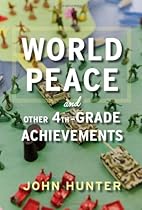 |
World Peace and Other 4th-Grade Achievements
|
| Click here to learn more or to order at Amazon.com discounted SL 2.... |
Product Description
In John Hunter’s classroom, students fearlessly tackle global problems and discover surprising solutions by playing his groundbreaking World Peace Game. These kids—from high school all the way down to fourth grade, in schools both well funded and underresourced—take on the roles of politicians, tribal leaders, diplomats, bankers, and military commanders. Through battles and negotiations, standoffs and summits, they strive to resolve dozens of complex, seemingly intractable real-world challenges, from nuclear proliferation to tribal warfare, financial collapse to climate change.
In World Peace and Other 4th-Grade Achievements, Hunter shares the wisdom he’s gleaned from over thirty years teaching the World Peace Game. Here he reveals the principles of successful collaboration that people of any age can apply anywhere. His students show us how to break through confusion, bounce back from failure, put our knowledge to use, and fulfill our potential. Hunter offers not only a forward-thinking report from the front lines of American education, but also a generous blueprint for a world that bends toward cooperation rather than conflict. In this deeply hopeful book, a visionary educator shows us what the future can be.
Editorial Reviews
Review
"John Hunter's World Peace Game is more than a brilliant example of educational game design. It shows us exactly how to inspire and manage creative collaboration around the most complex problems imaginable. And given that virtually all young people today are growing up gamers, this book is a must-read for twenty-first century educators and leaders." — Jane McGonigal, author of Reality Is Broken: Why Games Make Us Better and How They Can Change the World
"Hunter's optimism is infectious" — Publishers Weekly
"With numerous reflections on the game’s impact on certain students and a resounding final chapter highlighting his class’s 2012 visit to the Pentagon, Hunter proves the value of “slow teaching” in this important, fascinating, highly readable resource for educators and parents alike." — Booklist
About the Author
A native Virginian and graduate of Virginia Commonwealth University, JOHN HUNTER is an award-winning teacher and educational consultant. Hunter led his first sessions of the World Peace Game at Richmond Community High School in 1978. Since then, he has taught the game successfully in a variety of settings, from public schools in Virginia and Maryland to a session with Norwegian students sponsored by the European Youth Initiative. He has spoken at the Aspen Ideas Festival, Google’s Palo Alto campus, the Pentagon, the United Nations, and elsewhere. His March 2011 TED talk was greeted with a standing ovation, and Arianna Huffington and Chris Anderson named it the No. 1 talk of TED 2011.
JOIN SL 2.0
SUBSCRIBE TO
SCHOOL LEADERSHIP 2.0
Feedspot named School Leadership 2.0 one of the "Top 25 Educational Leadership Blogs"
"School Leadership 2.0 is the premier virtual learning community for school leaders from around the globe."
---------------------------
Our community is a subscription-based paid service ($19.95/year or only $1.99 per month for a trial membership) that will provide school leaders with outstanding resources. Learn more about membership to this service by clicking one of our links below.
Click HERE to subscribe as an individual.
Click HERE to learn about group membership (i.e., association, leadership teams)
__________________
CREATE AN EMPLOYER PROFILE AND GET JOB ALERTS AT
SCHOOLLEADERSHIPJOBS.COM
New Partnership
Mentors.net - a Professional Development Resource
Mentors.net was founded in 1995 as a professional development resource for school administrators leading new teacher induction programs. It soon evolved into a destination where both new and student teachers could reflect on their teaching experiences. Now, nearly thirty years later, Mentors.net has taken on a new direction—serving as a platform for beginning teachers, preservice educators, and
other professionals to share their insights and experiences from the early years of teaching, with a focus on integrating artificial intelligence. We invite you to contribute by sharing your experiences in the form of a journal article, story, reflection, or timely tips, especially on how you incorporate AI into your teaching
practice. Submissions may range from a 500-word personal reflection to a 2,000-word article with formal citations. Click here to explore and contribute an article.
Also, consider the exciting learning opportunity offered through the Mentors.net AI Academy.
© 2026 Created by William Brennan and Michael Keany
Powered by

