School Leadership 2.0
A Network Connecting School Leaders From Around The Globe
Book of the Week: The Talent Code: Greatness Isn't Born. It's Grown. Here's How. By Daniel Coyle
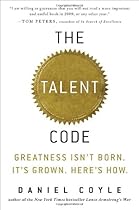 |
The Talent Code: Greatness Isn't Born. It's Grown. Here's How.
|
Product Description
What is the secret of talent? How do we unlock it? In this groundbreaking work, journalist and New York Times bestselling author Daniel Coyle provides parents, teachers, coaches, businesspeople—and everyone else—with tools they can use to maximize potential in themselves and others.
Whether you’re coaching soccer or teaching a child to play the piano, writing a novel or trying to improve your golf swing, this revolutionary book shows you how to grow talent by tapping into a newly discovered brain mechanism.
Drawing on cutting-edge neurology and firsthand research gathered on journeys to nine of the world’s talent hotbeds—from the baseball fields of the Caribbean to a classical-music academy in upstate New York—Coyle identifies the three key elements that will allow you to develop your gifts and optimize your performance in sports, art, music, math, or just about anything.
• Deep Practice--Everyone knows that practice is a key to success. What everyone doesn’t know is that specific kinds of practice can increase skill up to ten times faster than conventional practice.
• Ignition--We all need a little motivation to get started. But what separates truly high achievers from the rest of the pack? A higher level of commitment—call it passion—born out of our deepest unconscious desires and triggered by certain primal cues. Understanding how these signals work can help you ignite passion and catalyze skill development.
• Master Coaching--What are the secrets of the world’s most effective teachers, trainers, and coaches? Discover the four virtues that enable these “talent whisperers” to fuel passion, inspire deep practice, and bring out the best in their students.
These three elements work together within your brain to form myelin, a microscopic neural substance that adds vast amounts of speed and accuracy to your movements and thoughts. Scientists have discovered that myelin might just be the holy grail: the foundation of all forms of greatness, from Michelangelo’s to Michael Jordan’s. The good news about myelin is that it isn’t fixed at birth; to the contrary, it grows, and like anything that grows, it can be cultivated and nourished.
Combining revelatory analysis with illuminating examples of regular people who have achieved greatness, this book will not only change the way you think about talent, but equip you to reach your own highest potential.
Editorial Reviews
From Publishers Weekly
Journalist Coyle travels the world to discover the truth about talent in this fascinating account that studies how individuals can unlock their full potential and bring their talents to light. The discoveries put forth by Coyle come down to three main elements: coaching, motivation and practice. While these hardly seem like breakthroughs, Coyle's discovery process proves fascinating. Providing detailed examples from a variety of different sources, Coyle's work becomes as motivational as the stories he presents. John Farrell reads with a voice that is at once firm yet highly identifiable. The resulting recording serves as a fine instructional guide for those searching for how to fulfill their dreams. A Bantam hardcover (Reviews, Apr. 6). (Apr.)
Copyright © Reed Business Information, a division of Reed Elsevier Inc. All rights reserved.
Review
"I only wish I'd never before used the words 'breakthrough' or 'breathtaking' or 'magisterial' or 'stunning achievement' or 'your world will never be the same after you read this book.' Then I could be using them for the first and only time as I describe my reaction to Daniel Coyle's The Talent Code. I am even willing to 'guarantee' that you will not read a more important and useful book in 2009, or pretty much any other year. And if all that's not enough, it's also 'a helluva good read.'"—Tom Peters, author of In Search of Excellence
"This is a remarkable—even inspiring—book. Daniel Coyle has woven observations from brain research, behavioral research, and real-world training into a conceptual tapestry of genuine importance. What emerges is both a testament to the remarkable potential we all have to learn and perform and an indictment of any idea that our individual capacities and limitations are fixed at birth."—Dr. Robert Bjork, Distinguished Professor and Chair of Psychology, UCLA
About the Author
Daniel Coyle is the author of the New York Times bestseller Lance Armstrong’s War and Hardball: A Season in the Projects, and is a contributing editor forOutside magazine. He lives with his wife and four children in Homer, Alaska, where he coaches a rapidly improving Little League team.
JOIN SL 2.0
SUBSCRIBE TO
SCHOOL LEADERSHIP 2.0
Feedspot named School Leadership 2.0 one of the "Top 25 Educational Leadership Blogs"
"School Leadership 2.0 is the premier virtual learning community for school leaders from around the globe."
---------------------------
Our community is a subscription-based paid service ($19.95/year or only $1.99 per month for a trial membership) that will provide school leaders with outstanding resources. Learn more about membership to this service by clicking one of our links below.
Click HERE to subscribe as an individual.
Click HERE to learn about group membership (i.e., association, leadership teams)
__________________
CREATE AN EMPLOYER PROFILE AND GET JOB ALERTS AT
SCHOOLLEADERSHIPJOBS.COM
New Partnership
Mentors.net - a Professional Development Resource
Mentors.net was founded in 1995 as a professional development resource for school administrators leading new teacher induction programs. It soon evolved into a destination where both new and student teachers could reflect on their teaching experiences. Now, nearly thirty years later, Mentors.net has taken on a new direction—serving as a platform for beginning teachers, preservice educators, and
other professionals to share their insights and experiences from the early years of teaching, with a focus on integrating artificial intelligence. We invite you to contribute by sharing your experiences in the form of a journal article, story, reflection, or timely tips, especially on how you incorporate AI into your teaching
practice. Submissions may range from a 500-word personal reflection to a 2,000-word article with formal citations. Click here to explore and contribute an article.
Also, consider the exciting learning opportunity offered through the Mentors.net AI Academy.
© 2026 Created by William Brennan and Michael Keany
Powered by

