School Leadership 2.0
A Network Connecting School Leaders From Around The Globe
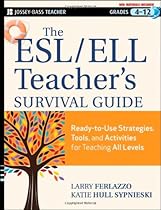
Book of the Week: The ESL/ELL Teacher’s Survival Guide: Read to Use Strategies, Tools, and Activities for Teaching All Levels
“The Electronic Journal for English as a Second Language”
The ESL/ELL Teacher’s Survival Guide: Read to Use Strategies, Tools, and Activities for Teaching All Levels
Click here to learn more or to order from our Book Store at Amazon....
August 2013 – Volume 17, Number 2
The ESL/ELL Teacher’s Survival Guide: Read to Use Strategies, Tools, and Activities for Teaching All Levels
Publisher: San Francisco, California: Jossey-‐Bass 322 pages 978-‐1-‐118-‐09567-‐6 $29.95 USD
All too often teachers are required to come up with innovative, content-‐based lessons for their students on a daily basis with little time to search. Teachers of ESL, both seasoned and novice, will benefit greatly from having The ESL/EFL Teacher’s Survival Guide in their arsenal. This multi-‐purpose book is written by two California ESL teachers who sought to offer a book based on interesting teaching strategies they have used for years in their own classrooms. In addition to their classroom testing, Ferlazzo and Hull-‐Sypnieski provide supporting research for all of their teaching suggestions. They also recognize the need to satisfy state-‐mandated standards (a sample outline of the California State ESL/ELD standards can be seen throughout the book). While the book is written specifically for grades 4-‐12, the lessons are varied, making it easily adapted for adult learners.
The book is divided into five parts, each consisting of two to three chapters. In Chapter 1, “ESL Instruction: The Big Picture,” the authors reference Stephen Krashen’s paper about compelling input. This paper proposes the idea that when input is notably compelling, learners forget they are using another language, and instead focus on the task at hand.
This concept is reflected throughout the book’s instructional strategies, so teachers can be sure they are compelling students to become intrinsically motivated in their English studies. The chapter explains various aspects of English language teaching and learning that one would only encounter in ESL teacher courses. This includes the variety of acronyms used in TESOL, the stages of language development, Basic Interpersonal Communication Skills (BICS) versus Cognitive Academic Language Proficiency (CALP), and a quick overview of ESL best practices which provides the basic do’s and don’ts of language teaching.
In Chapter 2, “ESL Classroom Basics: Building a Positive and Effective Learning Environment,” the authors explore the notion of creating an engaging and supportive classroom. This does not directly deal with a specific language skill, yet it is an essential foundation for all ESL classrooms before learning can take place. This is why this chapter comes before all others in the book. The chapter introduces the three-‐Rs relationships, resources and routines–which are then detailed further with specific strategies. We see eight different activities for encouraging relationship–growth between teacher and student as well as student and student. The ice-‐breaker ideas integrate multiple language skills and are meant to encourage students to move about the classroom, expressing themselves freely to their peers and teacher. The resource ideas range from classroom word walls to meaningful technology use.
Parts two and three, intended for beginning and intermediate ELLs respectively, each contain two chapters. The first chapters of parts two and three are dedicated to “Key Elements of a Curriculum” and give explicit instruction for several teaching and learning activities. While the chapters are divided into “Reading and Writing” and “Speaking and Listening,” readers will see that all the activities integrate more than one language skill. The activities vary greatly, so there is something in this book for every teaching style. The chapter begins with a list of the California English Language Development domains for each language level, which are then referenced after each activity to verify the domains being satisfied.
The second chapters are intended for “Daily Instruction for ELLs.” While the first chapter covers different elements for the ESL classroom, “Daily Instruction” details the application of these elements to the classroom on a daily basis. It covers ideas for student reflection before and after activities, homework assignments, inspiring field trip ideas that correlate to the material, and methods of assessment. Perhaps what helps the book live up to its “survival guide” name is the Sample Week section that outlines a lesson plan for each day of the week, each day being subdivided into “Speaking and Listening” and “Reading and Writing” activities. The remainder of the chapter is
TESL-EJ 17.2, August 2013 Ferlazzo & Hull Sypnieski/Christino 2
dedicated to the Year-‐Long Schedule which is broken up into thematic units and contains several more activities. A very useful aspect of this book is the gray box on almost every page called Tech Tool. These boxes list websites and smartphone applications that teachers can either use as resources for material or for directing their students for further instruction outside of the classroom. Teachers must incorporate technology into their curriculum and, upon further investigation of the websites, they prove to be easily accessible and relevant to the material. Some examples of the sites are cloze exercises with music for listening practice, interactive games for building vocabulary and even creating virtual field trips as a class. The Tech Tool feature alone makes the book worth the cost, as it provides resources that the authors have tested and approved.
Part four contains four briefer chapters that offer the reader ways of teaching ELLs in the mainstream classroom. This is something that is not usually included in ESL teacher handbooks, and it remains a very difficult task for many educators whose classes extended beyond an ESL-‐centered curriculum. The authors introduce the idea of the Organizing Cycle, whose concepts are summarized in five steps along with their application to a mainstream class with ELLs enrolled. Part five, “Further Strategies to Ensure Success,” comprises three more chapters. Two chapters in this part are dedicated to assessment of ELLs and dealing with classroom problems. It is impressive how the authors paid great attention to aspects of teaching that often do not get covered in teaching handbooks.
There are not many handbooks available to teachers that are so explicit in their guidance and present hundreds of lesson ideas, supported both by teachers and highly-‐regarded research. If an ESL teacher could have one book,The ESL/ELL Teacher’s Survival Guide should be that book, as the strategies are ready to use and can be tailored to students of any age or level of proficiency. The authors write with a genuine eagerness to share their knowledge and to inspire all of their readers to continue their growth as educators.
Reviewed by
Grace Christino
University of Central Florida Grace.christino@gmail.com
JOIN SL 2.0
SUBSCRIBE TO
SCHOOL LEADERSHIP 2.0
Feedspot named School Leadership 2.0 one of the "Top 25 Educational Leadership Blogs"
"School Leadership 2.0 is the premier virtual learning community for school leaders from around the globe."
---------------------------
Our community is a subscription-based paid service ($19.95/year or only $1.99 per month for a trial membership) that will provide school leaders with outstanding resources. Learn more about membership to this service by clicking one of our links below.
Click HERE to subscribe as an individual.
Click HERE to learn about group membership (i.e., association, leadership teams)
__________________
CREATE AN EMPLOYER PROFILE AND GET JOB ALERTS AT
SCHOOLLEADERSHIPJOBS.COM
New Partnership
Mentors.net - a Professional Development Resource
Mentors.net was founded in 1995 as a professional development resource for school administrators leading new teacher induction programs. It soon evolved into a destination where both new and student teachers could reflect on their teaching experiences. Now, nearly thirty years later, Mentors.net has taken on a new direction—serving as a platform for beginning teachers, preservice educators, and
other professionals to share their insights and experiences from the early years of teaching, with a focus on integrating artificial intelligence. We invite you to contribute by sharing your experiences in the form of a journal article, story, reflection, or timely tips, especially on how you incorporate AI into your teaching
practice. Submissions may range from a 500-word personal reflection to a 2,000-word article with formal citations. Click here to explore and contribute an article.
Also, consider the exciting learning opportunity offered through the Mentors.net AI Academy.
© 2026 Created by William Brennan and Michael Keany
Powered by

