School Leadership 2.0
A Network Connecting School Leaders From Around The Globe
Book of the Week: Effective Educational Programs, Practices, and Policies for English Learners
Effective Educational Programs, Practices, and Policies for English Learners
reviewed by Najah Alsaedi — February 08, 2016
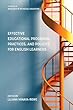 Title: Effective Educational Programs, Practices, and Policies for English Learners
Author(s): Liliana Minaya-Rowe (Ed.)
Publisher: Information Age Publishing, Charlotte
ISBN: 1623968577, Pages: 256, Year: 2014
Search for book at Amazon.com
The number of English Language Learners (ELLs) and multilingual students in the U.S. has dramatically increased during this current decade, and the estimated increase of ELLs has surpassed 150% since 1990 (Goldenberg & Coleman, 2010, p. 108). This growth makes adequately educating pre-service trainees to accommodate ELLs one of the major challenges facing teacher preparation programs. There is a lack of proper preparation for teachers to meet the needs of ELLs; this widens the gap between what teachers are trained to do and what they need to do to teach students who cannot meet academic demands. This leaves educators in a predicament concerning how to minimize this gap and help ELLs meet academic demands in mainstream classes.
Liliana Minaya-Rowe’s edited volume Effective Educational Programs, Practices, and Policies for English Learners is part of the Research in Bilingual Education series that addresses educational issues involving ELLs and provides applicable solutions. Her book focuses on training U.S. teachers to meet the needs of ELLs and foster multilingualism and multiculturalism in American classes. This volume is a collection of nine scholarly research articles written by practitioners, teacher trainers, researchers, administrators, and policymakers, and aims to meet both the linguistic and academic needs of English Language learners in the U.S. context. The book’s underlying assumption is that ELLs will be able to survive school and master both the academic content and English Language demands if their needs are appropriately met.
Minaya-Rowe begins the volume with an article that aims to present the challenges that ELLs encounter in meeting Common Core State Standards (CCSS) requirements, and provides guidance in light of theory and research. The following two chapters focus on scaffolding as a model to teach new content, such as science and mathematics, along with language. The fourth chapter explicates a teacher-generative model to teach science and language in three high school contexts, and concludes that the study sheds light on the importance of understanding ELL student needs in mainstream classes without a one-size-fits-all approach. Chapter Five presents an example of integrating language into the elementary school art curriculum. Chapter Seven discusses a flexible preparation program for content teachers and special education teachers to effectively educate and assess ELLs to meet the requirements of CCSS.
Chapter Six shifts towards policy, provides evidence for teacher capability in delivering suitable instruction and practice, and discusses the ability of educators to be policy makers within policy contexts. The final two chapters discuss implementing the dual language approach as a way to help ELLs overcome prospective difficulties. Chapter Eight presents an example of dual language programs for grades PK–8 in New England which aims to enable ELLs to communicate in two languages and two cultures while also succeeding academically. Chapter Nine directs its attention toward higher education, specifically the needs of ELLs and using the dual language approach to improve professional competency in their majors. These nine articles call educators to abandon traditional theories that teach language in isolation of academic content, and promote language as an “action that is developed, with support, in and through meaningful and engaging activities across the curriculum” (p. 3).
The strength of Effective Educational Programs lies in the examples it provides for implementing English within academic contents for ELLs from kindergarten through higher education. It starts with an article that presents relevant research, theory, and main challenges that ELLs face. The book’s strength is also its empirical evidence for integrating language within academic content to help ELLs triumph over potential academic language and content challenges. The majority of chapters have figures and tables, like curriculum maps and project graphics, which facilitate textual understanding.
Effective Educational Programs, Practices, and Policies for English Learners is a book that provides valuable empirical research studies, but is not written in a beginning-to-end progression. The chapters would be better organized if they were divided into major themes. Although this book is primarily addressed to teachers and school and university stakeholders in the U.S., it would be beneficial for English Foreign Language (EFL) contexts and English-medium schools and colleges abroad. Overall, I highly recommend this book for second language teachers, administrators, and teacher training program developers because it presents applicable examples for integrating second language learning and academic content as a way to help ELLs overcome some challenges in mastering academic context.
References
Goldenberg, C., & Coleman, R. (2010). Promoting academic achievement among English learners. A guide to research. Thousand Oaks, CA: Corwin Press.
| Cite This Article as: Teachers College Record, Date Published: February 08, 2016 http://www.tcrecord.org ID Number: 19405 |
JOIN SL 2.0
SUBSCRIBE TO
SCHOOL LEADERSHIP 2.0
Feedspot named School Leadership 2.0 one of the "Top 25 Educational Leadership Blogs"
"School Leadership 2.0 is the premier virtual learning community for school leaders from around the globe."
---------------------------
Our community is a subscription-based paid service ($19.95/year or only $1.99 per month for a trial membership) that will provide school leaders with outstanding resources. Learn more about membership to this service by clicking one of our links below.
Click HERE to subscribe as an individual.
Click HERE to learn about group membership (i.e., association, leadership teams)
__________________
CREATE AN EMPLOYER PROFILE AND GET JOB ALERTS AT
SCHOOLLEADERSHIPJOBS.COM
New Partnership
Mentors.net - a Professional Development Resource
Mentors.net was founded in 1995 as a professional development resource for school administrators leading new teacher induction programs. It soon evolved into a destination where both new and student teachers could reflect on their teaching experiences. Now, nearly thirty years later, Mentors.net has taken on a new direction—serving as a platform for beginning teachers, preservice educators, and
other professionals to share their insights and experiences from the early years of teaching, with a focus on integrating artificial intelligence. We invite you to contribute by sharing your experiences in the form of a journal article, story, reflection, or timely tips, especially on how you incorporate AI into your teaching
practice. Submissions may range from a 500-word personal reflection to a 2,000-word article with formal citations. Click here to explore and contribute an article.
Also, consider the exciting learning opportunity offered through the Mentors.net AI Academy.
© 2026 Created by William Brennan and Michael Keany
Powered by

