School Leadership 2.0
A Network Connecting School Leaders From Around The Globe
Blueprint for Tomorrow: Redesigning Schools for Student-Centered Learning
Blueprint for Tomorrow: Redesigning Schools for Student-Centered Learning
reviewed by Robert Kelly — December 15, 2016
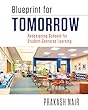 Title: Blueprint for Tomorrow: Redesigning Schools for Student-Centered Learning
Author(s): Prakash Nair
Publisher: Harvard Education Press, Cambridge
ISBN: 1612507042, Pages: 206, Year: 2014
Search for book at Amazon.com
THE PREMISE
In Blueprint for Tomorrow: Redesigning Schools for Student-Centered Learning, author Prakash Nair presents the case that it is senseless to waste money on repairing dated school designs that are increasingly educationally irrelevant. Instead, funding should be put toward school modification and design that enables progressive 21st-century educational practices focusing on student-centered learning. Established educational practices like project-based learning, personalized learning, and social-emotional learning inform the understanding of student-centered learning for this volume. The book is located in the transformation of educational practice from the industrial model with teacher-centered orientations designed around information delivery and passive learner compliance (referred to by the author as the cells and bells model) to more progressive orientations that are student-centered in nature. These new models are designed around diverse experiential learning communities intended for collaborative exploration and creativity. These experiential communities allow students to direct their own learning. This gives meaningful context to disciplinary understanding and collaborative creativity through engagement in real world problems for potential audiences.
Blueprint for Tomorrow’s focus on innovative school design for student-centered learning considers many other factors contributing to the transformation from a teacher-centered orientation. Pedagogy, curriculum design, teacher education, and professional development are some of these essential considerations as the book deals with the chicken/egg conundrum regarding the point of entry for educational transformation through school redesign. Imaginative redesign is necessary for accommodating and promoting progressive educational practices. However, professional educational culture must also be equipped with the appropriate tactics and strategies not only to necessitate these spaces, but also to maximize their educational potentials.
ORGANIZATION
The progressive and sequential build of this volume begins in Chapter One, "'Reading' School Buildings: A Visual Literacy Primer," where the initial layers of design lenses that are central to this book are established. These include the four design principles: be welcoming, be versatile, support varying and specific activities, and send positive messages through the six supportive strategies. These strategies are student-centered learning, teacher collaboration, positive school climate, technology integration, flexible scheduling, and connection to the environment, community, and global networks. Chapters Two to Eight take readers through the school environment one spatial component at a time to explore the transformative design potential of each space as part of the larger ecology of a student-centered learning community. This comprehensive journey through redesign possibilities of school space begins with entry into the school. This includes moving through hallways and classrooms, integrated learning areas, collaborative space for teachers, the school library, any connection with outdoor spaces, and the cafeteria space.
Chapter Three, Capturing More Space for Learning: Reconfiguring Classrooms and Hallways, acts as a key chapter by re-conceptualizing the traditional classroom where most teachers and learners spend their time. It points to the development of learning studios, learning suites, and small learning communities through an important additional design lens consisting of an expansive list of twenty modalities of learning where versatile educational spaces should strive to be accommodating in a 21st-century learning environment. These modalities span interdisciplinary study, storytelling, project-based learning through diverse discipline contexts such as naturalist, arts-based, or design-based learning, and collaborative and independent learning to name just a few. These modalities are informed by Thornburg's (1999) four primordial learning metaphors of the campfire, cave, watering hole, and life. The 21st-century learning studio is perceived as a versatile space for active learning. This is opposed to traditional classrooms acting primarily as spaces for passive learning with limited potential for diverse learning modalities. Nair also emphasizes the importance of scale and the need for small learning communities by design to increase educational efficacy in student-centered educational environments.
Chapter Four, Integrated Learning Areas: Labs, Studios, and Do-It-Yourself Spaces, is especially pertinent to many educators given the proliferation of the makerspace phenomenon in schools and community spaces. As with any popular wave in educational practice, there is always a danger that educators and schools are quick to bring these new ideas into their learning spaces without fully understanding the broader pedagogical and physical environments needed to sustain them and the educational culture necessary for them to flourish. There is also a broad range of contexts for an interdisciplinary studio going beyond the makerspace concept. The notion of the interdisciplinary studio is not a new one as the Reggio Emilia preschools in Italy were experimenting with the atelier concept as early as 1965 (Gandini, Hill, Cadwell, & Schwall, 2015). This chapter does an excellent job of exploring the range of possibilities of reconfiguring traditional science labs and how integrated learning areas can be designed for a variety of interdisciplinary contexts. This gives educators a range of practical applications to meet student needs. Nair’s five ideas for alternative spaces include the da Vinci arts/science studio, the Espresso studio for collaboration and interactivity, the Maker Lab (a makerspace akin to a garage workshop), the Jamie Oliver Studio built around agriculture, food, entrepreneurship, and culinary arts, and the Black Box Theater for interdisciplinary performative work and a myriad of multipurpose applications. Due its versatility and agility, Nair sees the Black Box Theater concept as a perfect representation of a learning building.
Blueprint for Tomorrow builds from these core chapters through varying school spatial contexts in the remaining chapters in a seamless fashion all in the context of 21st-century learning schools.
CONCLUSION AND ATTRIBUTES
The concluding chapter is critical to the transformative value of this book as a variety of implementation strategies are described in detail. Perhaps this is one of the greatest strengths of this text. It is designed to be accessible and usable for educators and schools no matter where they are on the change continuum. Unfortunately, academic works espousing the virtues of educational change and transformation often begin to fail on transitional and implementation strategies. It is one thing to place the order, yet another to make it happen given the demanding reality of daily educational practice. Blueprint for Tomorrow does both well. It allows anyone to enter the described change process despite budgetary constraints, the scale of the spatial redesign, or level of change readiness. In this light, the content of this book serves as a catalyst for educational change as it enables several practical entry points. These positive aspects are enhanced by the liberal placement of supporting illustrations and before/after photographic sequences that were taken from the author's field experience in transforming spaces and designing new ones.
Finally, if education is to evolve into an active practice of collaborative creativity and not a predominantly passive and consumptive practice, change has to occur on several fronts. Learning environment design is one inextricably connected to several other factors contributing to educational transformation. Blueprint for Tomorrow does a proficient job of providing an accessible and practical resource for the design of student-centered learning communities in a 21st-century context. The ultimate litmus test comes down to a question we as educators and learners must ask ourselves. What kind of learning environment would we like to be in? If the answer is a learning environment where the educator is a designer, facilitator, collaborator, and mentor in a supportive educational community that empowers learners to create through the generation and prototyping of ideas in real world contexts across disciplines, then this book is certainly worth exploring.
References
Gandini, L., Hill, L., Cadwell, L., & Schwall, C. (Eds.). (2015). In the spirit of the studio: Learning from the atelier of Reggio Emilia. New York, NY: Teachers College Press.
Thornburg, D. D. (1999). Campfires in cyberspace. Lake Barrington, IL: Starsong.
| Cite This Article as: Teachers College Record, Date Published: December 15, 2016 http://www.tcrecord.org |
JOIN SL 2.0
SUBSCRIBE TO
SCHOOL LEADERSHIP 2.0
Feedspot named School Leadership 2.0 one of the "Top 25 Educational Leadership Blogs"
"School Leadership 2.0 is the premier virtual learning community for school leaders from around the globe."
---------------------------
Our community is a subscription-based paid service ($19.95/year or only $1.99 per month for a trial membership) that will provide school leaders with outstanding resources. Learn more about membership to this service by clicking one of our links below.
Click HERE to subscribe as an individual.
Click HERE to learn about group membership (i.e., association, leadership teams)
__________________
CREATE AN EMPLOYER PROFILE AND GET JOB ALERTS AT
SCHOOLLEADERSHIPJOBS.COM
New Partnership
Mentors.net - a Professional Development Resource
Mentors.net was founded in 1995 as a professional development resource for school administrators leading new teacher induction programs. It soon evolved into a destination where both new and student teachers could reflect on their teaching experiences. Now, nearly thirty years later, Mentors.net has taken on a new direction—serving as a platform for beginning teachers, preservice educators, and
other professionals to share their insights and experiences from the early years of teaching, with a focus on integrating artificial intelligence. We invite you to contribute by sharing your experiences in the form of a journal article, story, reflection, or timely tips, especially on how you incorporate AI into your teaching
practice. Submissions may range from a 500-word personal reflection to a 2,000-word article with formal citations. Click here to explore and contribute an article.
Also, consider the exciting learning opportunity offered through the Mentors.net AI Academy.
© 2026 Created by William Brennan and Michael Keany
Powered by

